When anxiety tightens its grip, listening to specially designed music for as little as 24 minutes can significantly reduce those overwhelming feelings. Recent research from Toronto Metropolitan University confirms what many of us have experienced firsthand: the right soundscapes genuinely calm racing thoughts, slow racing hearts, and restore a sense of control.
You don’t need special equipment or training. Music works as an accessible, portable tool you can use anywhere, whether you’re sitting at your desk during a stressful workday, lying awake at night, or trying to ground yourself during a panic attack. The options range from curated anti-anxiety playlists and binaural beats to nature sounds, lo-fi beats, classical compositions, and even your own comfort songs that carry personal meaning.
The key lies in understanding which types of music match your needs in the moment. Slow tempos and predictable patterns typically work best for acute anxiety, while ambient soundscapes help maintain calm throughout the day. Some people respond to frequency-based tracks or white noise, others to soft piano or instrumental jazz. What matters is finding what genuinely soothes your nervous system, not following a one-size-fits-all prescription.
This isn’t about replacing professional support or medication when you need it. Music serves as one practical strategy in your broader mental health toolkit, something you can reach for when anxiety rises and you need immediate relief. Let’s explore the specific types that research and real-world experience show work best.
Key Takeaway: Research shows 24 minutes of purposefully composed music can measurably lower anxiety by influencing your nervous system, heart rate, and thought patterns. This evidence supports music as a legitimate tool alongside other strategies like
grounding techniques or
workplace anxiety help.
How We Chose These Anxiety-Calming Music Formats
We built this list using criteria that matter when you’re in the middle of an anxious moment and need something that actually works. We didn’t test products in a lab. Instead, we drew on what the research shows, what mental health professionals recommend to their clients, and what people managing anxiety report helps them get through hard days.
Here’s what guided our selections:
- Research-backed effectiveness, including findings from the Toronto Metropolitan University study showing 24 minutes of specially-designed music can significantly reduce anxiety
- Accessibility on major streaming platforms like Spotify, YouTube, and meditation apps so you can find relief without barriers
- Variety in format, from curated playlists and therapy-focused albums to nature sounds and binaural beats, recognizing different formats work for different people
- Real-world testimonials and clinical recommendations from therapists who use music with anxiety clients and individuals with lived experience
- Immediate usability during anxiety episodes without requiring special equipment or training
This isn’t a ranked list of “best to worst.” Each format serves different needs and moments. Some people find peace in classical piano, others in lo-fi beats or rain sounds. We included options that span these preferences while staying grounded in what evidence and experience tell us can genuinely help calm an anxious nervous system.
12 Music Formats and Styles That Help Calm Anxiety
1. Specially-Designed Anxiety Relief Music
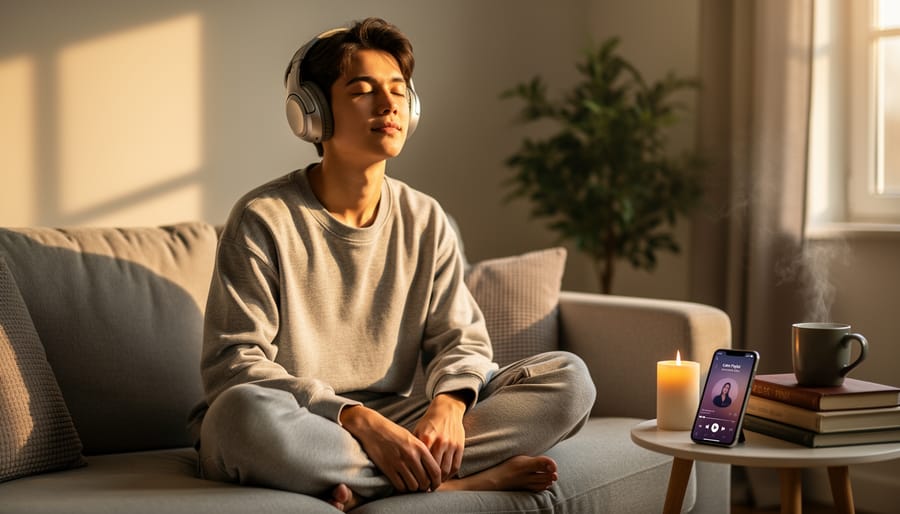 A calm moment of listening shows how music can become a safe, grounding ritual during anxious times.
Researchers at Toronto Metropolitan University found that listening to just 24 minutes of specially-designed music can significantly reduce anxiety. This isn’t your typical relaxation playlist. These compositions are intentionally crafted with specific elements proven to calm the nervous system: tempos between 60-80 beats per minute that mirror a resting heart rate, absence of lyrics that might trigger unwanted thoughts, and carefully selected frequencies that promote relaxation rather than stimulation.
What sets this music apart is its purpose. While your favorite song might lift your mood, specially-designed anxiety relief music is engineered for physiological calm. Look for albums explicitly labeled for anxiety or stress relief on streaming platforms. The deliberate absence of sudden changes, the sustained tones, and the predictable patterns create a sonic environment where your nervous system can begin to settle. You’re not just listening to something pleasant, you’re engaging with a tool designed specifically for the challenge you’re facing.
2. Curated Anti-Anxiety Playlists
Pre-made playlists like Spotify’s ‘Anti Anxiety Music and Anti-Stress Calm Sounds’ remove a key barrier when you’re already feeling overwhelmed: choosing what to play. During an anxiety spike, scrolling through hundreds of options can feel impossible. These curated collections solve that problem by offering tested combinations of calming tracks you can start in seconds.
The real advantage is accessibility during crisis moments. When your thoughts are racing and decision-making feels paralyzing, having a trusted playlist saved means one tap brings relief. No searching, no deliberating, no second-guessing whether this song or that artist will help.
These playlists also benefit from crowd wisdom. Popular anti-anxiety collections reflect what thousands of listeners have found soothing, creating a low-risk entry point if you’re new to using music for anxiety management. Save a few options to your library now, so they’re ready when you need them most.
3. Music Therapy Albums for Depression and Anxiety
Music therapy albums represent a step beyond general relaxation tracks. These compositions draw on clinical music therapy principles, intentionally structuring tempo, key changes, and instrumentation to support emotional regulation. The Relaxation Music Therapy artist’s album “Music for Anxiety: Stress Relief, Music to Help With Depression, Relaxing Music for Anxiety and Soothing Zen Garden Music” exemplifies this approach, combining elements specifically sequenced to address anxious states.
What sets music therapy albums apart is their informed design. Rather than simply creating pleasant sounds, these works consider how the brain processes rhythm and melody during distress. They often progress from matching an anxious state to gradually guiding the listener toward calm, a technique called entrainment that music therapists use in clinical settings.
You’ll find these albums on streaming platforms, making therapeutic principles accessible without needing a formal therapy session. They work well when you want something more structured than ambient noise but less demanding than active listening. The lengthy titles aren’t marketing fluff; they signal the composer’s intent to address specific emotional needs.
4. Nature Sounds and Ambient Recordings
Nature sounds occupy a unique space in anxiety relief because they aren’t technically music, yet they work through similar calming mechanisms. Rain, ocean waves, rustling leaves, and gentle streams provide what your anxious mind often craves: predictable, rhythmic patterns that drown out racing thoughts without demanding your attention.
These ambient recordings work by masking the mental noise that feeds anxiety. When your brain latches onto a steady rain pattern or the whoosh of waves, it has less bandwidth for spiraling worry loops. The repetitive nature creates a sonic anchor, gently pulling focus away from intrusive thoughts. There’s also a primal element at play: these sounds connect us to environments our nervous systems recognize as safe, triggering associations with shelter, calm weather, or peaceful outdoor spaces.
Accessibility makes nature sounds especially practical for anxiety management. YouTube offers thousands of hours of free recordings. Apps like Calm and Headspace include nature sound libraries. Every major streaming platform has ambient nature playlists you can queue up in seconds. Many people find them ideal for sleep, work background, or those middle-of-the-night anxiety spikes when silence feels too loud.
5. Classical Music with Slow Tempos
 Ocean waves create steady, rhythmic sound and a calming visual that many people associate with anxiety relief.
Classical music, particularly pieces with slow tempos between 60 and 80 beats per minute, offers a scientifically grounded approach to calming anxiety. This tempo range matters because it mirrors your resting heart rate, encouraging your cardiovascular system to slow down and synchronize with the music, a physiological shift that signals your body it’s safe to relax.
Baroque composers like Bach and Vivaldi created movements that naturally fall into this calming range, but you’ll find the most accessible anxiety relief in the dreamy works of Claude Debussy and Erik Satie. Debussy’s “Clair de Lune” and Satie’s “Gymnopédies” exemplify this gentle, flowing quality, melodies that drift rather than demand attention.
The beauty of classical music for anxiety lies in its predictability without monotony. You get harmonic richness and emotional depth, but without jarring dynamics or unexpected changes that might spike your nervous system. Try listening during evening wind-down routines or whenever you need to shift from high-alert mode into something gentler.
6. Binaural Beats and Frequency-Based Music
Binaural beats work by playing two slightly different frequencies in each ear through headphones, your brain perceives a third “beat” at the difference between them. Theta waves (4-8 Hz) and delta waves (0.5-4 Hz) are thought to encourage deep relaxation and calm brain states similar to meditation or sleep. The theory is that your brain synchronizes with these frequencies, shifting away from the faster beta waves associated with anxious thinking.
The research on binaural beats is mixed. Some studies suggest modest anxiety reduction, while others find little measurable effect beyond placebo. What’s undeniable is the strong anecdotal support from people who use them regularly. Many report feeling noticeably calmer after 15-20 minutes of listening, particularly when combined with intentional rest or breathing exercises.
For best results, use headphones in a quiet space where you can close your eyes and minimize distractions. Binaural beats work as background support during meditation or as a wind-down tool before sleep, not as multitasking music.
7. Instrumental Jazz and Acoustic Guitar
Gentle instrumental jazz and acoustic guitar offer a uniquely human quality that many find comforting during anxious moments. Unlike electronic ambient sounds, these formats feature the subtle imperfections and expressive nuances of live performance, a guitarist’s fingerpicking pattern, the breathy tone of a saxophone, the resonance of wood and strings. This organic texture provides emotional warmth without the potential triggers that lyrics can introduce, making it easier to stay present rather than getting caught in song narratives.
The melodic nature keeps your attention gently anchored without demanding focus, which makes instrumental jazz and acoustic guitar particularly effective as background music during daily activities. You can listen while working, cooking, or moving through your morning routine, letting the music create a calmer atmosphere without pulling you away from what you’re doing. Look for artists in the “smooth jazz” or “contemporary instrumental” categories, or search for acoustic guitar compilations that emphasize fingerstyle playing over energetic strumming. The key is finding pieces that flow smoothly, avoiding sudden tempo changes or sharp dynamic shifts that might jar you out of the calm state you’re building.
8. Meditation and Mindfulness Music
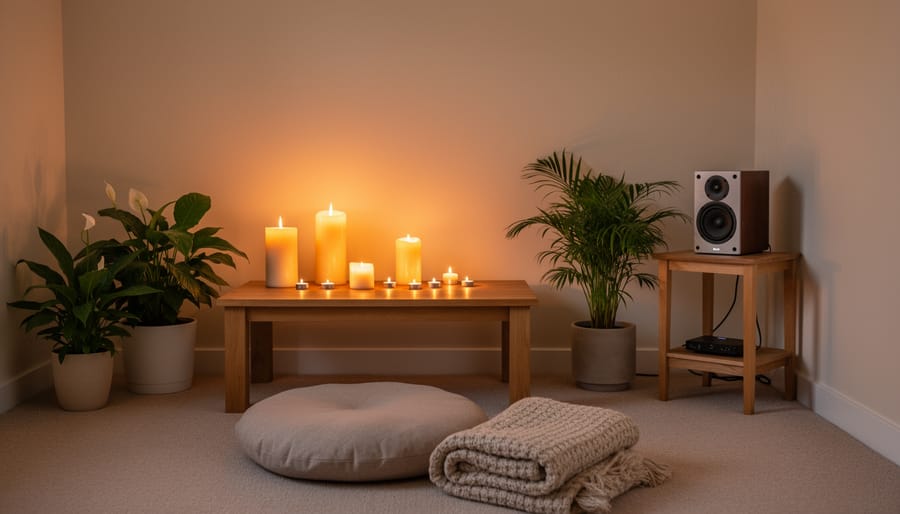 A simple, candlelit listening space suggests how ambient sound can support mindfulness and ease tension.
Meditation and mindfulness music creates a sonic environment designed to support present-moment awareness. Unlike background music you might ignore, these soundscapes feature sustained tones, Tibetan singing bowls, soft chimes, and gentle percussion that give your mind something to anchor to without demanding active listening.
You’ll often find this music paired with guided meditation apps, but it works powerfully on its own. The slow, deliberate sounds encourage deeper breathing and can help interrupt anxious thought spirals by giving your attention a neutral focal point. Many people find that the resonant quality of singing bowls or the delicate shimmer of chimes creates a physical sensation of calm, almost like the sound is clearing space in your mind.
This format bridges intentional mindfulness practice with passive anxiety relief. You can use it during formal meditation sessions or simply play it in the background during anxious moments, letting the repetitive, centering sounds do their work without requiring you to actively engage.
9. Lo-Fi and Chill Beats
Lo-fi hip-hop and chill beats have become a go-to soundtrack for many people navigating anxiety, especially during work, study, or creative tasks. These instrumental tracks feature mellow, repetitive loops, soft drum patterns, and warm, dusty samples that create a predictable sonic environment without demanding your attention. The genre’s signature crackling vinyl sounds and unhurried tempo (typically around 70-90 BPM) provide just enough structure to anchor wandering thoughts without pulling focus from what you’re doing.
What makes lo-fi particularly effective for anxiety is its low-stakes quality. There are no dramatic crescendos, jarring transitions, or emotional peaks to navigate. The music stays deliberately in the background, offering gentle companionship rather than performance. Platforms like YouTube and Spotify host 24/7 lo-fi streams, meaning you can simply press play and let it run for as long as you need that calming presence. Many people find it helps create a buffer between themselves and external stressors, turning overwhelming silence into manageable quiet.
10. White Noise and Pink Noise
White noise and pink noise aren’t music in the traditional sense, but they’re powerful anxiety management tools often found alongside calming playlists. White noise contains all frequencies at equal intensity, creating a steady “shhhh” sound, while pink noise emphasizes lower frequencies for a softer, deeper quality similar to rainfall or rustling leaves. Both work through masking: they cover up sudden sounds that might trigger anxiety spikes, whether that’s a car horn outside, voices through walls, or the refrigerator hum you can’t stop noticing. This consistent sonic blanket helps anxious brains let go of hypervigilance, the exhausting state of constantly scanning for threats. Many people use these sounds for sleep support, as they maintain steady volume throughout the night without the dynamic shifts that wake you. During daytime anxiety, white or pink noise through headphones creates a personal sound boundary in overwhelming environments like open offices or crowded spaces, giving your nervous system permission to focus inward rather than processing every external stimulus.
11. Soft Piano and Ambient Electronic
Modern ambient composers bring a unique approach to anxiety relief by merging the emotional depth of classical piano with subtle electronic textures. Artists like Max Richter and Ólafur Arnalds create soundscapes that feel both intimate and expansive, offering comfort without demanding your full attention.
This genre works particularly well for anxiety because it provides emotional connection without intensity. The piano grounds you in something familiar and human, while ambient electronics create a calming sonic space around you. These compositions often unfold slowly, with gentle repetition and minimal sudden changes, which helps your nervous system settle.
What makes this format powerful is its ability to hold emotional weight while remaining soothing. Unlike purely clinical relaxation music, soft piano and ambient electronic pieces acknowledge complexity and depth, which can feel validating when you’re struggling. They create room for your feelings without amplifying them.
Try listening during transitions in your day, moments when anxiety often creeps in, or as background during creative work when you need gentle presence without distraction.
12. Your Personal Comfort Music
 Headphones with soft, drifting light suggest frequency-based calm and the idea of quieting mental noise.
The most effective anxiety-calming music might not be on any research-approved playlist, it could be the song your grandmother hummed, the album that got you through high school, or the soundtrack to your favorite childhood film. For one person, heavy metal provides the release their nervous system needs; for another, it’s 90s R&B or a specific podcast theme song. The research points us toward slow tempos and instrumental tracks, but your lived experience matters more than any study’s averages.
Note: What calms your nervous system is uniquely yours, trust your own response.
Give yourself permission to experiment beyond the ‘should’ list. If death metal grounds you, use it. If a particular pop song makes your shoulders drop and your breathing slow, that’s your medicine. Some people find comfort in music with lyrics that articulate their anxiety, feeling heard and less alone. Others need complete silence or nature sounds without any human voice. The goal isn’t finding the ‘correct’ calming music; it’s discovering what genuinely shifts your state. Keep a short mental or actual list of songs that have helped before, and trust that your comfort music counts just as much as any specially-designed track.
How to Use Music to Calm Anxiety in Daily Life
The most effective way to use music for anxiety relief depends on your unique needs and daily rhythm. Research shows that 24 minutes of specially-designed music can significantly reduce anxiety, but you don’t need to wait for a crisis to benefit. Many people find that weaving calming music into their everyday routine creates a foundation of calm that helps them weather stress more easily.
During an acute anxiety episode, put on headphones if possible. The immersive quality blocks out external triggers and helps you focus on the music’s calming rhythm. If headphones aren’t available or feel too isolating, speakers work fine, especially at home where you control the environment. Start with one of the formats from this list that feels right in the moment, whether that’s nature sounds, binaural beats, or your personal comfort music, and give yourself permission to simply listen without multitasking.
Preventive listening works just as well as reactive use. Consider these practical ways to integrate calming music into your day:
- Play soft instrumental or ambient music for 20-30 minutes before a known stressor like a work presentation or difficult conversation
- Create a bedtime playlist that signals your nervous system it’s time to wind down, starting 30-45 minutes before sleep
- Use lo-fi beats or classical music as background during tasks that typically spike your anxiety
- Pair breathing exercises with meditation music to deepen relaxation, inhale for four counts, hold, exhale for six while the music plays
- Keep a go-to playlist on your phone for unexpected anxiety moments when you need immediate support
- Experiment with different formats throughout the week to discover what truly resonates with your nervous system
You can also combine music with other evidence-based techniques you already use. If you practice progressive muscle relaxation or grounding exercises, adding a calming soundtrack often enhances the effect. The key is making music a regular companion in your anxiety management toolkit, not just an emergency measure. Trust your instincts about what feels supportive, and remember that what works shifts over time. Your needs today might differ from your needs next month, and that’s perfectly okay.
What the Research Tells Us About Music and Anxiety
The Toronto Metropolitan University study offers compelling evidence for what many people managing anxiety have experienced firsthand: listening to just 24 minutes of specially-designed music can significantly reduce anxiety symptoms. This research validates music as more than comfort, it’s a measurable intervention that affects your body’s stress response in real time.
The science behind music’s calming effect centers on three key mechanisms. First, tempo synchronization: when you listen to music with a slower tempo (typically 60-80 beats per minute), your heart rate and breathing naturally align with that rhythm, triggering your parasympathetic nervous system, the body’s rest-and-digest mode. Second, cognitive distraction: music occupies mental space that might otherwise fuel anxious rumination, giving your mind something structured and predictable to focus on instead of spiraling thoughts. Third, emotional regulation: certain musical elements activate brain regions involved in processing emotions, helping you move through anxious states rather than staying stuck in them.
What matters most isn’t just any background sound, but music intentionally composed for anxiety relief, typically instrumental, with minimal tempo changes and frequencies that promote calm rather than alertness.
Common Questions About Music for Anxiety Relief
Music often raises practical questions when you’re considering it as an anxiety management tool. Here’s what you need to know.
Does calming music work for everyone with anxiety?
Music affects people differently based on personal preferences, past associations, and individual nervous system responses. While research shows that 24 minutes of specially-designed music can significantly reduce anxiety for many people, some may find silence or other strategies more helpful.
How long should I listen to music to feel calmer?
Recent research suggests that 24 minutes of anxiety-reducing music can produce measurable effects, but you might notice relief sooner or prefer longer sessions. Listen as long as it feels helpful, whether that’s five minutes during an acute episode or an hour as part of your evening routine.
Can I use music alongside other anxiety treatments?
Absolutely. Music works well as a complementary tool with therapy, medication, breathing exercises, and other anxiety management strategies. It’s an additional resource in your toolkit, not a replacement for professional treatment when you need it.
Is music better than medication for anxiety?
Music is not a substitute for medication or professional mental health care. Think of it as a supportive practice that can enhance your overall approach to managing anxiety, similar to exercise or mindfulness, rather than a standalone treatment.
What if certain music makes me feel more anxious?
That’s a valid response. Some songs carry emotional associations or have qualities that heighten rather than calm your nervous system. Trust your instincts and switch to different formats, or try nature sounds and ambient recordings that feel more neutral.
If you’re experiencing intense anxiety that music alone isn’t helping, or if you need immediate support during a crisis, reach out to a mental health professional. Music can be one part of learning how to stop a panic attack but it’s most effective when used as part of a broader strategy that includes the right professional guidance for your situation.
Finding the right music for your anxiety is a personal journey, and there’s no single “correct” answer. What calms one person might not work for another, and that’s completely okay. The evidence shows music can be a powerful tool, 24 minutes can make a measurable difference, but it works best when you approach it with curiosity rather than pressure. Try different formats, notice what helps, and give yourself permission to experiment without judgment.
Note: Music is one strategy in your anxiety management toolkit. For additional support, Mental Health Support offers real-time chat and helpline services, along with resources to
find the right therapy for your needs.
Remember that using music for anxiety doesn’t mean you’re avoiding “real” treatment. It’s a valid, accessible form of self-care that can complement therapy, medication, or other approaches you’re already using. Some days, pressing play on a calming playlist might be the kindest thing you can do for yourself. Trust your instincts, be patient with the process, and know that reaching for support in whatever form it takes is a sign of strength, not weakness.