Yes, you can calm anxiety in under two minutes.
When your heart is racing, your thoughts are spiraling, and panic feels like it’s taking over, grounding techniques offer a lifeline you can use right where you are. These aren’t long meditation sessions or complex therapeutic exercises. They’re fast-acting tools that work by interrupting your stress response and bringing your nervous system back to baseline, often in 90 seconds or less.
Right now, your body is flooded with stress hormones that trigger physical symptoms like rapid heartbeat, shallow breathing, and muscle tension. Grounding techniques short-circuit this cascade by engaging your senses and redirecting your brain’s attention away from the threat response. Research shows these methods regulate heart and respiratory rates, reduce muscle tension, and calm brain activity almost immediately.
Whether you’re dealing with workplace anxiety a sudden panic attack, or overwhelming stress from any source, you don’t need special equipment or training. The five techniques in this guide require nothing more than your awareness and a willingness to try something that feels counterintuitive when you’re in distress: slowing down and noticing what’s happening around you instead of inside your head.
I know how it feels when someone suggests breathing exercises while you’re drowning in anxiety. It sounds too simple to possibly work. But these methods are backed by evidence showing they calm the body, mind, and nervous system by engaging specific sensory pathways that signal safety to your brain. You’ll learn exactly how to use each technique, what to expect when you try them, and how to tell they’re working.
Key Takeaway: Effective grounding shows up as slower breathing, reduced heart rate, releasing muscle tension, and calmer thoughts. You don’t need to feel completely calm, noticing any positive shift means the technique is working.
What You Need to Get Started
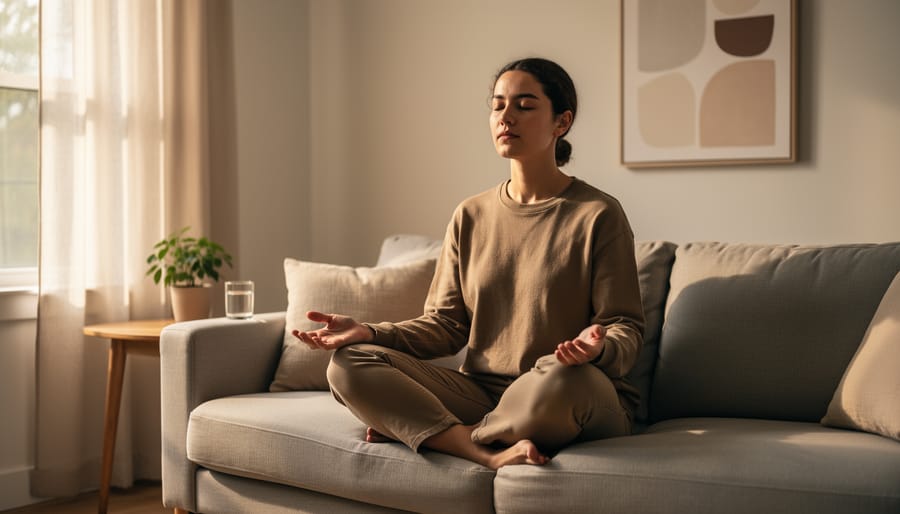 A calm moment captured in a quiet space shows someone settling their body to bring anxiety down quickly.
The good news: you don’t need any special equipment, apps, or training to start reducing your anxiety right now. These grounding techniques rely entirely on tools you already carry with you, your breath, your five senses, and your ability to direct your attention. No purchases required, no preparation needed.
Here’s what you have access to in this moment:
- Your breath, which you can control and slow down
- Your five senses, sight, touch, sound, smell, and taste
- Your body’s natural ability to shift from panic to calm
- Optional: cold water from any tap or a textured object (fabric, ice cube, smooth stone)
- A brief moment to pause, even if it’s just 60 seconds
That’s genuinely it. These techniques work whether you’re sitting at your desk, standing in a crowded subway, lying in bed at 3am, or in the middle of a panic attack. You don’t need privacy, silence, or ideal conditions. The accessibility is intentional, your nervous system responds to these methods regardless of your location or circumstances. If you can breathe and notice your surroundings, you can use these grounding techniques to interrupt the anxiety spiral happening in your body right now.
When to Use These Techniques (and When to Seek More Support)
Grounding techniques work best when you’re experiencing acute anxiety, feeling overwhelmed by racing thoughts, dealing with flashbacks, or noticing your body’s stress response kicking in. They’re particularly effective tools to stop a panic attack before it escalates, calm distressing mental loops, or bring yourself back to the present when emotions feel unmanageable. You can use these techniques anywhere, at work, in public, at home, whenever you notice anxiety building.
Warning: If you’re experiencing thoughts of self-harm or suicide, reach out to crisis support immediately by calling 988, texting a crisis line, or going to your nearest emergency department.
That said, grounding techniques aren’t a replacement for professional mental health care. They won’t address underlying anxiety disorders, trauma, or conditions that benefit from ongoing therapy or medication. Think of them as immediate relief tools within a broader anxiety management approach, not a substitute for working with a therapist or psychiatrist when you need it. If your anxiety significantly interferes with daily life, worsens over time, or you find yourself relying solely on these techniques without improvement, it’s time to seek professional support.
Reaching out for help isn’t a sign of weakness, it’s a practical step toward managing anxiety effectively. Our organization offers real-time support options and can connect you with resources that match your needs. Sometimes the bravest thing you can do is ask for more support than quick techniques can provide.
The 5 Grounding Techniques: Step-by-Step
Technique 1: The 5-4-3-2-1 Sensory Method
This method works because it forces your brain to shift from anxious thought spirals to direct sensory observation. When you’re naming what you can physically see, touch, and hear right now, you’re engaging the senses in a way that interrupts the stress response and anchors you firmly in the present moment.
Here’s how to do it:
- Name 5 things you can see. Look around your space and identify five objects. Be specific, don’t just say “chair,” say “the blue office chair with the worn armrest.” Notice details like color, texture, or shape.
- Acknowledge 4 things you can touch. Physically reach out and feel four different surfaces or objects. Press your feet into the floor, run your hand along a smooth desk, feel the fabric of your shirt, touch something cool or textured.
- Notice 3 things you can hear. Listen carefully for three distinct sounds. Maybe it’s the hum of the refrigerator, distant traffic, your own breathing, or birds outside. Focus on each sound individually for a moment.
- Identify 2 things you can smell. This can be trickier, but try to notice even subtle scents, coffee, lotion on your hands, fresh air, fabric softener. If you can’t smell anything where you are, move slightly or recall two distinct smells.
- Name 1 thing you can taste. Notice what you can taste in your mouth right now, maybe coffee from earlier, toothpaste, or just the neutral taste of your own mouth. You can also take a sip of water or bite of something if available.
If you’re somewhere with limited options, like a bland office space or a crowded subway, get creative. The pattern on someone’s shoe counts. The texture of your own palm works. The sound of your breath is always there. What matters is the focused attention, not finding exotic sensory experiences.
“I was having a panic attack in the bathroom at work,” says Emma, 34. “I couldn’t name all the smells, so I focused harder on what I could see and touch instead. By the time I finished the exercise, my heart had stopped racing.”
The 5-4-3-2-1 method is similar to the 3-3-3 rule but engages all five senses rather than focusing on sight, sound, and movement alone. Both work by redirecting your attention outward when anxiety pulls you inward.
Technique 2: Box Breathing (4-4-4-4 Method)
Box breathing is one of the fastest ways to interrupt a panic response because it directly targets your autonomic nervous system. When anxiety spikes, your breathing becomes shallow and rapid, which signals danger to your brain. This technique reverses that signal by imposing a slow, controlled rhythm that tells your body you’re safe.
Here’s how to do it:
- Inhale slowly through your nose for four seconds, filling your lungs completely.
- Hold your breath for four seconds without straining or tensing.
- Exhale steadily through your mouth for four seconds, releasing all the air.
- Pause with empty lungs for four seconds before beginning the next cycle.
Repeat this pattern four to six times, or until you notice your heart rate slowing and your thoughts becoming clearer.
The beauty of box breathing is its portability. You can count silently at a meeting, in a crowded train, or lying in bed at 3 a.m. If you lose track of the count, don’t panic, just start the next breath at step one. Some people visualize tracing a square in their mind, spending four seconds on each side, which helps maintain focus when anxious thoughts try to intrude.
This technique works particularly well during panic attacks because it physically prevents hyperventilation. Within 60 to 90 seconds, you’ll typically feel the tight chest sensation ease and the racing heart begin to settle. Your body responds to the oxygen-carbon dioxide balance you’re creating, which reduces stress hormones and signals your nervous system to shift out of fight-or-flight mode.
Technique 3: Cold Water Stimulation
 Cold water splashed on the face evokes an immediate reset that helps calm the nervous system during intense anxiety.
Cold water on your face triggers something remarkable: the dive reflex, an evolutionary response that instantly shifts your nervous system from panic mode to calm. When cold water contacts your face, particularly around your eyes and forehead, your heart rate slows, blood vessels constrict, and your body redirects resources away from the fight-or-flight response. This happens within seconds, making it one of the fastest physical interventions for intense anxiety.
Here’s how to use it: Fill your hands with cold water from a tap and splash it directly onto your face, focusing on your forehead, eyes, and cheeks. Alternatively, soak a washcloth in cold water, wring it out, and press it firmly against your face for 30 seconds. If you’re at home and experiencing severe panic, you can briefly submerge your face in a bowl of cold water, holding your breath for 10 to 15 seconds.
The water should feel cold but not painfully so. Don’t use ice water or extreme temperatures, which can shock your system rather than calm it. Skip this technique if you have certain heart conditions or respiratory issues, as the dive reflex affects heart rate and breathing patterns.
This method works best during moments of intense panic when you need immediate physical intervention. The sensation is impossible to ignore, which makes it particularly effective when your thoughts are racing and other grounding techniques feel too subtle.
Technique 4: Focused Sensory Grounding
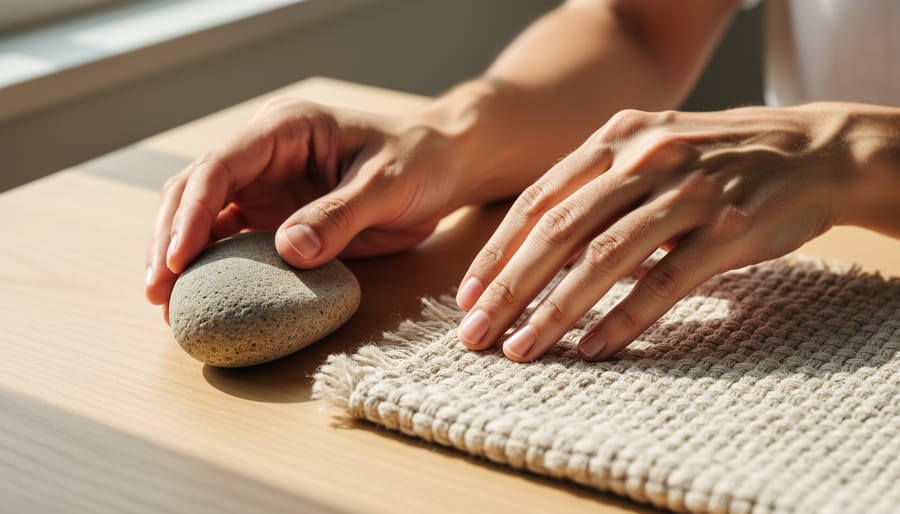 Tactile sensations like a smooth stone or textured fabric can anchor you in the present when anxiety spikes.
When anxiety floods your system, sometimes the simplest approach works best. Focused sensory grounding narrows your attention to a single, intense sensory experience, your brain can’t fully panic and fully concentrate on physical sensation at the same time.
Pick one anchor and commit to it completely. Hold an ice cube in your palm and notice everything: the cold spreading across your skin, water trickling between your fingers, the sharp edges softening as it melts. Run your thumb across a textured object, a piece of fabric, tree bark, your jeans, and focus only on what you feel: rough, smooth, raised, woven. Listen to a specific sound in your environment, a fan humming, traffic outside, your own breathing, and follow it like a thread pulling you back to the present.
The key is depth, not variety. Describe the sensation to yourself in detail. If your mind wanders to anxious thoughts, gently return to the physical experience. What temperature is it? How does it change? What exact texture are you feeling?
This technique works especially well during high distress because it’s less cognitively demanding than tracking multiple senses. You’re not counting or following complex steps, you’re just feeling one thing, right now. That singular focus interrupts the anxiety spiral and gives your nervous system a chance to regulate.
Common anchors you can access anywhere: the feeling of your feet on the floor, a pen’s texture in your hand, the temperature of air on your face.
Technique 5: Body Scan and Progressive Release
When anxiety locks into your body as a tight chest, clenched jaw, or knotted shoulders, this abbreviated body scan breaks the physical grip in under two minutes.
Start at your feet. Notice any tension, cold toes, tight arches, anything you’re holding there. Take a slow breath and imagine sending it down to that spot. As you exhale, consciously release whatever tightness you found. You’re not forcing relaxation; you’re just letting go.
Move up to your calves and thighs. Same process: notice, breathe in, release on the exhale. Then your stomach and chest, anxiety often camps out here as shallow breathing or a squeezed feeling. Breathe into that tightness. Let your belly expand. Release the clench.
Scan your shoulders, which tend to creep up toward your ears when you’re stressed. Drop them deliberately as you exhale. Check your jaw, your forehead, the space between your eyebrows. Anxiety hides tension in these small muscles.
This works because anxiety doesn’t just live in your thoughts, it lives in your body as muscle tension and restricted breathing. By methodically releasing that physical grip, you signal your nervous system that the threat has passed.
Use this technique when you feel anxiety manifesting physically: when your chest feels tight, your muscles ache from tension, or stress has you literally wound up. It’s especially helpful at night when physical tension keeps you awake, or during work stress when you notice your shoulders hunched over your keyboard.
How to Know It’s Working
You’ll know a grounding technique is working when you notice specific shifts in your body and mind. Your breathing will naturally slow and deepen, even if you weren’t consciously focusing on it. Your heart rate decreases, that tight feeling in your chest loosens, and the tension you’ve been holding in your shoulders or jaw starts to release. Mentally, your thoughts become less frantic and racing, and you might find yourself able to focus on what’s around you rather than being stuck in anxious loops.
Set realistic expectations for yourself. You’re not aiming for complete serenity in two minutes. What you’re looking for is a noticeable shift from acute distress toward manageability. Maybe your panic drops from an 8 out of 10 to a 5. That’s real progress, and it means you’ve interrupted the anxiety spiral.
Before you start a technique, take five seconds to notice where you are: how fast you’re breathing, where you feel tension, what your thoughts are doing. Then use the grounding method. Afterward, check in again with those same markers. This before-and-after awareness helps you recognize your personal anxiety cues and track what actually works for your body.
If the first technique doesn’t create a shift within a minute or so, that’s okay. Try a different one. Some people respond better to physical interventions like cold water, while others need the structured focus of counting or breathing. Be patient with yourself as you figure out what works. The more you practice these techniques, the more effective they become, because your nervous system learns to recognize and respond to the cues faster.
Making Grounding Part of Your Anxiety Management Strategy
Learning these techniques is just the beginning. The real power comes from making them a consistent part of how you respond to anxiety, not just reaching for them when you’re in crisis.
Practice these methods when you’re calm, even if it feels unnecessary. Run through the 5-4-3-2-1 exercise while waiting for coffee or try box breathing before bed. This trains your brain to recognize the pattern, making it easier to access when anxiety strikes. You’re building muscle memory for calm.
Pay attention to which techniques resonate with you personally. Some people find cold water immediately grounding, while others prefer the structured focus of counting breaths. Keep a simple note in your phone about what worked and when. This awareness helps you build a personalized toolkit instead of fumbling through options during distress.
These grounding techniques work best as part of a broader approach to managing anxiety. Consider whether you’d benefit from therapy, a mental health evaluation or other professional support. Grounding can work alongside medication, regular exercise, sleep routines, and connection with people who understand what you’re experiencing. They’re tools, not a complete solution.
Track your patterns over a few weeks. Notice what triggers your anxiety, which techniques help most, and how quickly you recover. This information empowers you to respond with intention rather than panic, giving you real control over how anxiety shows up in your life.
Common Questions About Immediate Anxiety Relief
Common Questions About Immediate Anxiety Relief
When you’re dealing with anxiety, you likely have questions about whether these techniques will actually work for you. Here are answers to the concerns we hear most often.
Can these really work in under 2 minutes?
Yes. Grounding techniques like the 5-4-3-2-1 method and box breathing have been shown to regulate heart and respiratory rates, reduce muscle tension, and calm the brain within 60 seconds to 2 minutes. The key is engaging fully with the technique rather than rushing through it.
What if I’m in public and feel self-conscious?
Most grounding techniques are completely invisible to others. Box breathing just looks like you’re breathing normally, the 5-4-3-2-1 method happens entirely in your mind, and a body scan appears as though you’re simply pausing for a moment. If you need something physical, stepping into a restroom to splash cold water on your face takes seconds and provides privacy.
Which technique should I try first?
Start with the 5-4-3-2-1 sensory method. It’s accessible anywhere, requires nothing but your attention, and works for most people experiencing acute anxiety. If that doesn’t resonate, box breathing is your next best option since it directly addresses the rapid breathing that often accompanies anxiety.
Can I combine techniques?
Absolutely. You might start with box breathing to slow your heart rate, then move into the 5-4-3-2-1 method to redirect your thoughts. Some people find that cold water stimulation followed by focused breathing creates a powerful one-two effect. Experiment to find what combination works best for you.
Do I need to practice these when I’m calm?
Practicing during calm moments makes the techniques more effective during crises. Your brain learns the pattern, and the relief response becomes almost automatic. Spend two minutes a day practicing your preferred method so it’s there when you need it most.
How often can I use grounding techniques?
As often as you need them. There’s no limit or risk of overuse. Some people use grounding multiple times daily, others only during particularly stressful moments. These are tools you can reach for whenever anxiety surfaces.
Will these work for panic attacks?
Grounding techniques are highly effective for calming during panic attacks. Cold water stimulation and box breathing are particularly powerful because they directly interrupt the physical panic response. While you may not stop a panic attack instantly, these methods can significantly reduce the intensity and duration of symptoms.
Remember that what works varies from person to person. If one technique doesn’t help, that doesn’t mean you’re doing something wrong or that grounding won’t work for you. It simply means you need to find the right fit. Be patient with yourself as you explore these options, and don’t hesitate to try a different approach if the first one doesn’t click.
You now have five proven techniques that can bring relief when anxiety feels overwhelming. These aren’t abstract concepts or distant goals, they’re immediate tools you can use right now, in this moment, wherever you are. Your breath, your senses, and your body are always with you, which means calm is always within reach.
Managing anxiety is ongoing work, and some days will be harder than others. These grounding techniques are one part of your toolkit, not the whole solution. They work alongside therapy, medication, support from loved ones, and the other strategies you’re building. There’s no shame in needing all of these things, seeking support is a sign of strength, not weakness.
If you’re struggling and need to talk to someone right now, we’re here. Our organization connects people to real-time mental health support and resources designed to meet you where you are. You don’t have to navigate this alone.
Anxiety may be part of your experience, but it doesn’t define you. With practice, these techniques can help you reclaim moments of peace, even in the middle of a storm. You’ve already taken an important step by being here. Keep going.