You’re sitting in your car outside the dentist’s office, heart pounding, palms sweating, even though your appointment isn’t for another twenty minutes. Or you’ve spent the entire week before a work presentation replaying worst-case scenarios in your head, losing sleep over something that might go perfectly fine. This is anticipation anxiety, and if you’re experiencing it, you’re far from alone.
Anticipation anxiety is the intense worry and physical distress that builds before an upcoming event, often out of proportion to the actual threat. Unlike the manageable butterflies before a big moment, this kind of anxiety can hijack your thoughts for days or weeks beforehand, creating a cycle of dread that sometimes feels worse than the event itself. You might recognize it in the stomach-churning unease before social gatherings, medical appointments, difficult conversations, or even positive events like weddings or job interviews.
What makes anticipation anxiety particularly challenging is how it compounds. The worry about the future event creates its own suffering in the present moment. You’re not just dealing with one stressful situation; you’re living through it repeatedly in your mind, each mental rehearsal adding another layer of exhaustion. Some people experience physical symptoms including nausea, headaches, muscle tension, and sleep disruption. Others find themselves avoiding situations entirely, which can shrink their world over time.
This pattern shares similarities with GAD symptoms but it’s typically focused on specific upcoming events rather than constant, generalized worry. Understanding this distinction matters because the strategies that help you manage anticipation anxiety can be tailored to these pre-event moments.
The good news? Anticipation anxiety responds well to targeted coping strategies, and recognizing the pattern is your first step toward breaking it.
What Is Anticipation Anxiety? Recognizing the Pattern
Anticipation anxiety is the worry that builds in the hours, days, or even weeks before something happens. It’s that escalating unease when you’ve got a job interview next Tuesday, or when you know you’ll see someone who makes you uncomfortable at a family gathering this weekend. Unlike generalized anxiety that can linger without a clear trigger, anticipation anxiety has a target. It’s always pointing forward, always rehearsing a future moment that hasn’t arrived yet.
Research describes how anticipation anxiety mounts alongside anticipation of events that may or may not materialize as feared.
What makes this type of anxiety particularly exhausting is its future focus. While panic attacks happen in the present and social anxiety activates in real-time interactions, anticipation anxiety lives entirely in your imagination of what’s coming. You’re not anxious about what’s happening now. You’re anxious about what might happen later.
Think about the week before an exam. Anticipation anxiety mounts as the examination date approaches, often intensifying rather than diminishing with time. The same pattern appears before medical appointments, first dates, presentations at work, or difficult conversations you’ve been putting off. Your mind starts running simulations, most of them catastrophic.
The pattern is remarkably consistent across different situations. You might notice yourself checking the calendar repeatedly, calculating how many days remain. Sleep becomes harder as the event draws closer. Your stomach might feel unsettled. You replay potential scenarios, scripting what you’ll say, imagining what could go wrong. Some people describe it as living the difficult moment over and over before it even happens.
What separates normal pre-event jitters from anticipation anxiety is intensity and interference. Feeling a bit nervous before giving a speech is expected. Losing sleep for three nights beforehand, avoiding preparation because thinking about it feels unbearable, and seriously considering calling in sick crosses into anxiety territory. When the worry becomes bigger than the actual event usually warrants, or when it starts changing your behavior weeks in advance, that’s anticipation anxiety asserting itself.
The cruel irony is that many people experiencing this type of anxiety don’t seek support until the pattern has already reshaped their lives, sometimes developing into avoidance of entire categories of experiences. Recognizing anticipation anxiety early matters because the sooner you identify the pattern, the more options you have for addressing it.
 A moment of uncertainty before an upcoming event can feel loud in your head, even while you’re physically still.
How Your Body and Mind Sound the Alarm
Your body doesn’t wait for the actual event to react. Days or even weeks before that presentation, social gathering, or medical appointment, your internal alarm system kicks into high gear. You might notice your heart racing while lying in bed at night, your mind jumping straight to the thing you’re dreading. Or maybe your stomach churns every time you think about what’s coming, even though it’s still days away.
These physical responses are real and measurable, not something you’re making up or exaggerating. Your racing heartbeat, the tightness in your chest, the shallow breathing, these are all part of your body’s threat response activating in advance. Some people experience sleep disruption, lying awake rehearsing conversations or scenarios that haven’t happened yet. Others deal with digestive issues, headaches, muscle tension, or fatigue that seems to settle in as the anticipated event draws closer.
The anxiety attack symptoms you experience aren’t limited to your body. Your mind gets caught in specific patterns that can feel impossible to escape. Rumination takes over, you replay the upcoming situation repeatedly, examining it from every angle, trying to predict every possible outcome. This mental rehearsal might feel productive, like you’re preparing yourself, but it often just deepens the anxiety groove.
Catastrophizing becomes your brain’s default mode. A simple work meeting transforms into a career-ending disaster in your imagination. A first date becomes a humiliating rejection. A routine doctor’s appointment becomes the moment everything falls apart. Your thoughts spiral toward worst-case scenarios, and each “what if” spawns ten more.
You might also notice excessive self-focus creeping in. You become hyperaware of how you’ll appear, how you’ll sound, whether people will judge you. This self-consciousness can be exhausting, consuming energy before the actual event even arrives.
Here’s what matters: these responses don’t mean you’re broken or weak. They’re your nervous system doing what it’s designed to do, trying to protect you from perceived danger. The problem isn’t that you’re experiencing these symptoms. The problem is that your alarm system is going off too early and too intensely for situations that don’t actually threaten your survival. Recognizing these patterns is the first step toward learning how to respond differently.
 Anticipation anxiety often shows up as restlessness, especially when the event is close and sleep becomes harder.
Why We Get Trapped in the “What If” Loop
Your brain isn’t broken when it spins out worst-case scenarios before an important meeting or medical appointment. It’s doing exactly what evolution designed it to do: scan for threats and prepare you to survive them. The problem is that our ancient alarm system can’t tell the difference between facing a predator and facing a difficult conversation with your boss. Both trigger the same fight-or-flight response, flooding your body with stress hormones and launching your mind into overdrive.
This is where the “what if” loop gets its power. Your brain treats uncertain future events as potential dangers that need solving right now. So it rehearses every possible outcome, searching for the one scenario that will keep you safe. Think of it like a smoke detector that goes off when you burn toast. The alarm is functioning perfectly, it’s just responding to something that isn’t actually a fire. Your anticipation anxiety works the same way, sounding alarms for situations that pose no real threat to your survival.
Here’s the catch that keeps so many people stuck. When you avoid the situation you’re worried about, whether that’s canceling plans, calling in sick, or finding an excuse to skip the event, your anxiety drops immediately. That relief feels like proof that you made the right choice, that the situation really was dangerous. Research shows that avoidance maintains danger in your mind because you never get the chance to learn that you could have handled it.
Note: The more situations you avoid, the more your brain continues to believe those situations are genuinely dangerous, creating a cycle that strengthens anticipation anxiety over time.
This creates what psychologists call a negative feedback loop. You worry about an event, avoid it, feel temporary relief, then face the same anxiety next time something similar comes up, only now it’s stronger because avoidance has reinforced your brain’s belief in the threat. Meanwhile, you never collect evidence that contradicts your worst-case predictions. You don’t discover that the presentation went fine, that people were supportive at the gathering, or that the awkward moment you feared never materialized.
The loop also feeds on something called probability inflation. When you’re anxious, your brain overestimates both the likelihood of bad outcomes and how catastrophic they’ll be. A stumble over your words becomes “everyone will think I’m incompetent.” A pause in conversation becomes “they hate me.” Your mind doesn’t just imagine one bad outcome, it chains them together into elaborate disaster scenarios that feel absolutely certain even though they’re built on guesswork and fear rather than evidence.
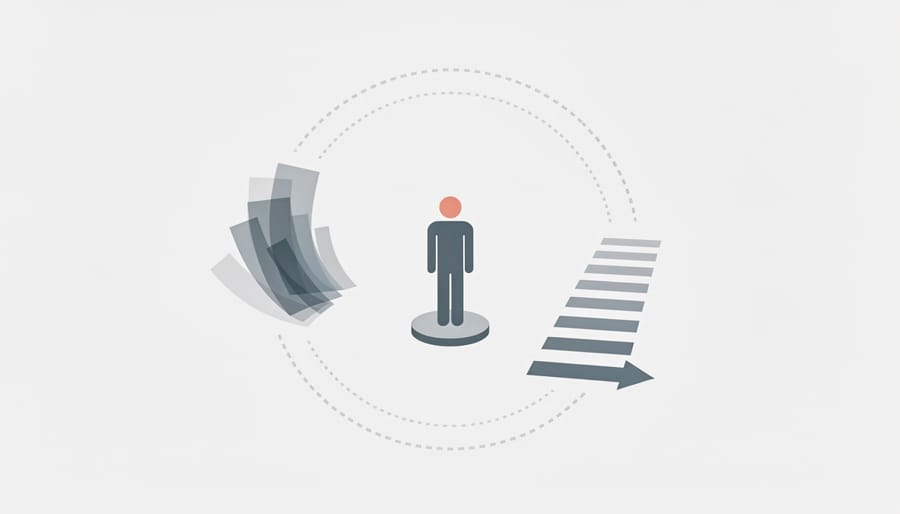 Feeling trapped between hesitation and the need to move forward can be part of the “what if” loop.
When Anticipation Anxiety Takes Over: Recognizing the Tipping Point
It’s helpful to understand the line between normal vs abnormal anxiety, especially when you notice your pre-event worry changing how you move through the world. There isn’t a precise moment when anticipation anxiety crosses over, but certain shifts signal it’s time to reach out for support.
Watch for patterns where your worry isn’t just uncomfortable but actively narrowing your life. Are you turning down opportunities you genuinely want because the anticipation feels too overwhelming? Maybe you’ve stopped applying for jobs, declined social invitations repeatedly, or canceled medical appointments not because you don’t want or need them, but because the buildup beforehand feels impossible to tolerate. When avoidance becomes your primary strategy, the anxiety often strengthens its grip.
Research shows that many people don’t seek professional support until they develop unbearable anticipatory anxiety or find themselves unable to leave familiar settings altogether. By that point, their world has often shrunk considerably. You don’t have to wait until anxiety feels unbearable to get help.
Notice if the physical symptoms have become constant companions. If racing thoughts, disrupted sleep, or stomach distress start days or weeks before events and rarely let up between them, your nervous system is working overtime. Similarly, if you spend hours mentally rehearsing worst-case scenarios in a loop that intrudes on work, relationships, or activities you once enjoyed, that’s a signal worth paying attention to.
The goal isn’t to frighten you but to empower you to recognize when you’re carrying more than you need to carry alone. Seeking support doesn’t mean you’ve failed or that something is fundamentally wrong with you. It means you’re choosing to address something that’s affecting your quality of life, and that’s a strength. If your anticipation anxiety is shaping your decisions more than your values and goals are, professional guidance can help you reclaim that space.
Breaking Free: Evidence-Based Coping Strategies That Actually Work
Facing It Down: Why Gradual Exposure Matters
Here’s what might sound backwards at first: the way to reduce anxiety about a future event is to actually move toward it, not away from it. When you avoid situations that trigger anticipation anxiety, you’re essentially teaching your brain that those situations really are dangerous. The more you sidestep them, the more you reinforce the belief that something terrible will happen if you face them.
Gradual exposure flips this script. Instead of avoiding what scares you, you approach it in small, manageable steps. Think of it like building tolerance. You wouldn’t expect someone afraid of deep water to dive into the ocean right away. They might start by standing at the water’s edge, then wading in ankle-deep, then knee-deep, slowly working up to swimming.
The same principle applies to anticipation anxiety. If you’re terrified of giving presentations, you don’t start with a keynote speech to 500 people. You might begin by practicing your talk alone in your room, then presenting to one trusted friend, then to a small study group. Each small success chips away at the catastrophic narrative your mind has constructed.
For exam-related worries, test anxiety tips often include taking practice tests in conditions that mimic the real thing, gradually increasing the pressure until test day feels familiar rather than terrifying.
Creating your own exposure plan doesn’t require a therapist, though professional guidance helps. Here’s how to start:
- Identify the specific situation triggering your anticipation anxiety and what exactly you fear will happen.
- Break the situation into smaller steps, ranking them from least to most anxiety-provoking.
- Start with the easiest step, staying in that situation until your anxiety naturally decreases by at least half.
- Move to the next step only after you’ve practiced the current one several times and your anxiety has genuinely diminished.
- Track your progress and celebrate small wins, noting how your predictions rarely match reality.
This process works because it gives your brain new information. Each time you face something and survive it without catastrophe, you’re rewriting the story. Yes, it’s uncomfortable. Your anxiety might spike initially. But that discomfort is temporary, while avoidance keeps you stuck indefinitely.
 Present-moment grounding can help you turn down the volume of future fears and reconnect with what’s happening right now.
Grounding Techniques for When Your Mind Races Ahead
When your thoughts sprint into next week while your body sits here today, grounding techniques act like an anchor, pulling you back to the present moment where anxiety has less fuel to burn.
Start with the 5-4-3-2-1 technique. Name five things you can see right now, four you can touch, three you can hear, two you can smell, and one you can taste. This simple exercise interrupts the mental rehearsal loop by forcing your attention onto immediate sensory information instead of imagined future scenarios.
Box breathing offers another quick reset. Breathe in for four counts, hold for four, exhale for four, hold for four. Repeat three to five rounds. The structured rhythm gives your racing mind something concrete to follow and signals your nervous system that you’re safe in this moment, not the hypothetical situation you’ve been catastrophizing about.
Physical grounding works too. Press your feet firmly into the floor and notice the sensation. Run cold water over your hands. Hold an ice cube. These tangible experiences snap you out of future-focused worry and remind your brain that right now, in this present moment, you’re okay.
You can also try a body scan. Starting at your toes, slowly move your attention up through your body, noticing tension without judging it. When you catch your mind jumping ahead to tomorrow’s presentation or next month’s appointment, gently redirect it back to wherever you are in the scan.
These aren’t magic fixes, but they’re practical tools you can use anywhere to interrupt the anticipation cycle and buy yourself a few moments of relief.
Rewriting the Script: Challenging Catastrophic Thinking
Your mind’s favorite horror movie is one where you’re the star and everything goes wrong. When anticipation anxiety kicks in, your thoughts skip straight to worst-case scenarios: “I’ll freeze during the presentation and everyone will think I’m incompetent,” or “This pain means something’s seriously wrong and the doctor will find terrible news.” These predictions feel like facts, but they’re actually thought distortions your anxious brain serves up as protection.
Start by catching the catastrophe in action. When you notice your thoughts spiraling toward disaster, pause and ask yourself: “What’s the actual evidence for this outcome?” Not feelings or hunches, but real proof. Then consider alternatives. If you’ve given ten presentations before without freezing, that’s data. If minor pains have turned out fine dozens of times, that’s evidence too.
Try the “best case, worst case, most likely case” exercise. Your brain’s already handling worst case without any help. Now deliberately imagine the best possible outcome, then land on what’s genuinely most probable based on your history. Most presentations go fine. Most doctor’s visits yield manageable news. Most social events include at least a few decent conversations.
This isn’t about pretending nothing could go wrong or dismissing real concerns. If you’re worried about a medical symptom, seeing the doctor is smart. The reframe is recognizing that “I’m concerned and taking appropriate action” is different from “I’m certain disaster awaits.” You’re teaching your brain to see shades of gray instead of only catastrophe.
Real Stories: How Others Navigate Anticipation Anxiety
Sarah’s hands started trembling three days before her sister’s wedding. Not during the ceremony itself, three days before. She’d lie awake rehearsing conversations, imagining awkward silences, picturing herself spilling wine on her dress. “I spent the entire week before completely exhausted from anxiety about something that hadn’t happened yet,” she recalls. “When the actual day arrived, I was so drained I could barely enjoy it.”
Her experience mirrors what many face when anticipation anxiety takes hold, though the triggers vary widely.
Marcus, a software developer, describes his pattern around work presentations. “I’d start obsessing about it the moment it got scheduled. By the time presentation day rolled around, I’d already lived through a hundred disastrous versions in my head.” He began tracking his thoughts in a journal, noticing that his worst-case scenarios almost never materialized. “Seeing that pattern on paper helped me recognize when I was spiraling. It didn’t stop the anxiety overnight, but it gave me something concrete to push back against.”
For Jennifer, medical appointments became her trigger point after a health scare. “Even routine checkups would send me into a tailspin days in advance. I’d cancel, reschedule, cancel again.” She recognized she’d crossed into territory where avoidance was running her life. Working with a therapist, she started with small steps, sitting in her car outside the clinic, then walking into the waiting room without an appointment. “Recovery wasn’t this neat upward line. Some weeks I’d take two steps forward, then slide back. But gradually, the anticipation lost some of its grip.”
David’s anticipation anxiety centers on social gatherings. He’s learned to give himself permission to leave early rather than avoiding events entirely. “I tell myself I’ll stay for thirty minutes. Usually, once I’m there, it’s not as overwhelming as I’d imagined. But knowing I can leave takes the edge off the buildup.”
What connects these stories isn’t that everyone conquered their anxiety completely. It’s that they found ways to stay engaged with their lives despite it, often through small, imperfect steps that accumulated over time.
You Don’t Have to Face This Alone: Getting Support
If your anticipation anxiety is disrupting your daily life, affecting your relationships, or keeping you from activities that matter to you, reaching out for professional support isn’t a failure. It’s a practical decision to work with someone who has the tools and training to help. You wouldn’t hesitate to see a doctor for a persistent physical condition, and your mental health deserves the same care.
Several therapy approaches have proven effective for anticipation anxiety. Cognitive Behavioral Therapy (CBT) helps you identify and challenge the catastrophic thinking patterns that fuel pre-event worry, then develop more balanced responses. Acceptance and Commitment Therapy (ACT) teaches you to accept anxious thoughts without fighting them while committing to actions that align with your values. Exposure-based therapy systematically helps you face feared situations in gradual steps, breaking the avoidance cycle that keeps anxiety strong. A therapist can tailor these approaches to your specific triggers and circumstances.
Accessing support has become more flexible than ever. Many people start by talking with their family doctor, who can provide referrals to mental health specialists. Community mental health centers often offer sliding-scale fees based on income. Online therapy platforms connect you with licensed therapists from home, which can reduce some of the anticipation anxiety about attending appointments. Employee assistance programs through your workplace may provide free sessions.
Note: Mental Health Support offers confidential resources including 24/7 crisis support, live chat with trained counselors, self-help tools, and connections to local services at mentalhealthsupport.ca.
Many people delay getting help because of concerns about mental health stigma or beliefs that they should handle it alone. Research shows that many individuals don’t seek treatment until their anticipatory anxiety becomes unbearable or they develop agoraphobia. Starting earlier means you can develop coping skills before anxiety narrows your world. Asking for help demonstrates self-awareness and courage, not weakness. You’re taking an active role in your wellbeing rather than waiting for things to worsen.
Remember that person from the beginning, lying awake at three in the morning, mentally rehearsing every possible disaster? That’s where so many of us start with anticipation anxiety, caught in a loop that feels impossible to escape. But here’s what matters: you’re reading this article, which means you’ve already taken the first step toward understanding what’s happening in your mind and body.
Anticipation anxiety is real, it’s measurable, and most importantly, it’s manageable. It doesn’t mean you’re broken or weak. It means your brain is doing what it evolved to do, sounding alarms to protect you from perceived threats. The difference now is that you have tools to respond differently.
You don’t need to transform overnight. Start small. Try one grounding technique before your next challenging event. Challenge one catastrophic thought. Take one tiny step toward something you’ve been avoiding. These moments add up, gradually teaching your nervous system that the future you’re dreading rarely unfolds the way your anxiety predicts.
And you genuinely don’t have to do this alone. Whether it’s reaching out to a therapist, connecting with others who understand, or using real-time support resources when the worry feels overwhelming, asking for help is an act of courage, not surrender. Your experience matters, your struggle is valid, and support exists when you’re ready for it.
The future your anxiety is rehearsing isn’t the only possible script. You’re already rewriting it, one day at a time.