Press your feet firmly into the floor right now. Notice five things you can see, four you can touch, three you can hear, two you can smell, and one you can taste. This grounding technique interrupts the anxiety spiral happening in your brain and brings you back to the present moment. You can use it anywhere, anytime the panic starts to rise.
Take a breath in for four counts, hold for four, exhale for six. That longer exhale activates your parasympathetic nervous system, the part responsible for calming your body down. When Sarah, a teacher from Vancouver, tried this during a particularly overwhelming staff meeting in 2026, she felt her racing heart slow within three cycles. The science backs this up: controlled breathing literally changes your body chemistry.
You’re not broken because you’re searching for anxiety relief at 2am or during your lunch break. You’re taking action, and that matters. Understanding what you’re experiencing is half the battle, which is why exploring resources like Anxiety 101 can help you recognize patterns and triggers.
The techniques that work best combine immediate physical intervention with longer-term practice. Your anxiety didn’t appear overnight, and while these methods provide real relief right now, building a toolkit takes time. Some people find progressive muscle relaxation helps within minutes. Others swear by cold water on their wrists or a quick walk around the block.
What works for you might be different from what works for your colleague or your sister. This article breaks down five evidence-based approaches that mental health professionals across Canada recommend in 2026. Each technique includes the why behind it, because understanding helps you trust the process when anxiety tells you nothing will work.
You deserve support, and relief is possible.
What Makes an Anxiety Relief Technique ‘Evidence-Based’?
When you’re struggling with anxiety, you’ll find no shortage of advice online. Social media influencers tout essential oils, wellness bloggers promote crystal healing, and your well-meaning friend swears by a technique they saw on TikTok. Some of these might offer comfort, but evidence-based anxiety relief techniques stand apart because they’ve been rigorously tested and consistently proven to work.
Evidence-based means a technique has undergone systematic research. Mental health professionals don’t just rely on anecdotal success stories or personal testimonials. They look for controlled clinical trials where researchers compare the technique against placebo treatments or standard care, measuring actual changes in anxiety symptoms over time. These studies get published in peer-reviewed journals where other experts scrutinize the methodology and results before publication.
The difference matters because anxiety is a real medical condition affecting your brain chemistry and nervous system. A technique that merely distracts you temporarily isn’t the same as one that creates measurable, lasting changes in how your brain processes fear and stress. Clinical trials track outcomes like reduced panic attack frequency, lower anxiety scores on standardized assessments, and improved daily functioning. When multiple studies across different research teams show similar positive results, that technique earns the evidence-based label.
Note: Mental health professionals evaluate anxiety techniques based on peer-reviewed research, replicable results across multiple studies, and measurable improvements in patient symptoms and functioning.
Mental health organizations regularly review this research to develop evidence-based anxiety guidelines that clinicians follow. These comprehensive reviews examine dozens or even hundreds of studies to determine which approaches consistently deliver results. When your therapist recommends a specific technique, they’re drawing on this accumulated body of research, not guessing or following trends.
This doesn’t mean untested approaches are necessarily harmful or useless. It simply means we don’t have scientific proof they work beyond individual experiences. For managing a condition as challenging as anxiety, you deserve strategies backed by solid evidence showing they help people like you.
1. Cognitive Behavioral Therapy (CBT) Techniques You Can Use Today
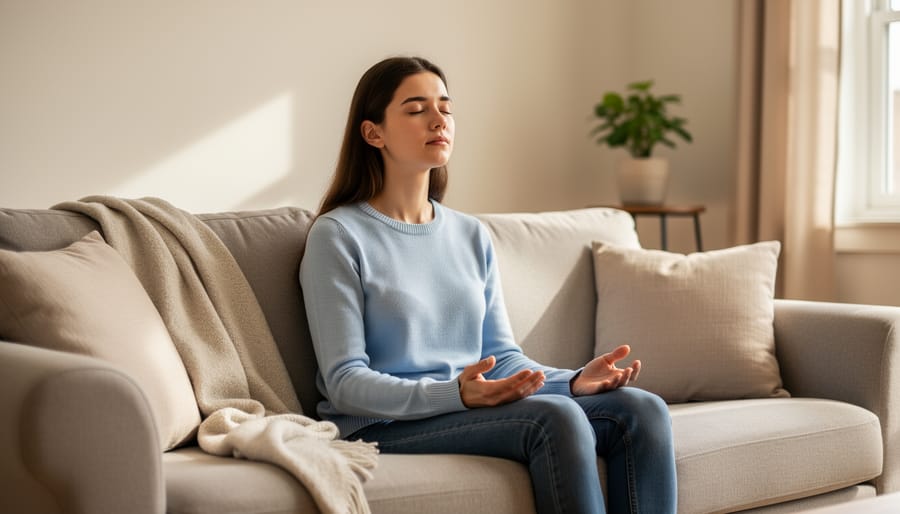 A calm moment captured in a quiet indoor setting conveys relief and safety while practicing anxiety-reducing skills.
Free Digital CBT Tools: The MindShift CBT App
If you want to practice CBT techniques on your own schedule, MindShift CBT is evidence-based and completely free to download. This app helps you reduce worry, stress, and panic through guided activities based on Cognitive Behavioral Therapy principles, the same techniques a therapist might teach you, but accessible whenever anxiety strikes.
The app includes features specifically designed for different anxiety triggers. If you’re dealing with social anxiety before a meeting, perfectionism that’s keeping you stuck, or panic symptoms that seem to come out of nowhere, MindShift offers targeted exercises for each situation. You’ll find quick Thought Journals to challenge anxious thinking patterns, guided relaxation exercises when you need to calm down fast, and gradual exposure tools to help you face situations you’ve been avoiding.
What makes MindShift particularly helpful is that it doesn’t just tell you anxiety is irrational, it teaches you how to work with your thoughts differently. The app guides you through identifying thinking traps, testing your anxious predictions against reality, and building new mental habits that reduce anxiety’s grip over time.
You can download MindShift CBT for free on both iOS and Android devices. Many Canadian mental health professionals recommend it as a solid starting point for anyone wanting to learn CBT skills independently, though it works best as part of a broader anxiety management approach that might include professional support when needed.
2. Progressive Muscle Relaxation for Physical Anxiety Symptoms
When your shoulders creep toward your ears, your jaw clenches tight, or your stomach ties itself in knots, you’re experiencing the physical grip anxiety has on your body. Progressive Muscle Relaxation (PMR) targets these exact sensations. This technique works by systematically tensing and then releasing specific muscle groups throughout your body, teaching you to recognize the difference between tension and relaxation while breaking the cycle of physical stress.
Mental health professionals recommend PMR because it interrupts the body’s fight-or-flight response. When you deliberately tense a muscle group for five to ten seconds and then release it, you activate your parasympathetic nervous system, the part responsible for calming you down. The contrast between tension and release helps you identify where you’re holding stress and gives your body a clear signal to let go.
Here’s how to practice PMR effectively:
- Find a quiet space where you can sit or lie down comfortably without interruptions.
- Start with your feet. Curl your toes tightly for five seconds, then release completely and notice the sensation of relaxation for ten to fifteen seconds.
- Move upward to your calves, thighs, buttocks, and abdomen, tensing each muscle group briefly before releasing.
- Continue through your hands (make fists), arms, shoulders (raise them toward your ears), and neck.
- Finish with your face, scrunch your forehead, squeeze your eyes shut, and clench your jaw, then let everything soften.
- Take three slow breaths and notice how your body feels now compared to when you started.
The entire sequence takes ten to fifteen minutes, but you’ll often feel relief before you finish. PMR proves particularly helpful when anxiety attack symptoms show up as physical tension rather than racing thoughts. Unlike the 3-3-3 rule which grounds you through sensory awareness, PMR directly addresses muscle tension.
Use this technique before bed if anxiety keeps you awake, during your lunch break when work stress builds, or as a daily practice to lower your baseline tension levels over time.
3. Grounding Techniques for Acute Anxiety and Panic
When anxiety hits hard or panic rises, you need something to stop the spiral in its tracks. Grounding techniques do exactly that, they interrupt the fight-or-flight response by anchoring your awareness to the present moment. Mental health professionals recommend these methods because they work with your nervous system, not against it.
Here’s what happens in your brain during a panic attack: your amygdala perceives threat and floods your system with stress hormones. Grounding techniques redirect your attention away from catastrophic thoughts and toward immediate sensory input, signaling to your brain that you’re safe right now. This shift activates your prefrontal cortex (the rational part) and calms the amygdala’s alarm bells.
The 5-4-3-2-1 technique is one of the most effective grounding exercises. Look around and name five things you can see, four you can touch, three you can hear, two you can smell, and one you can taste. This forces your brain to engage with concrete reality instead of anxious predictions. When you’re describing the texture of your chair or the sound of traffic outside, you can’t simultaneously spiral into worst-case scenarios.
Body scanning works differently but achieves the same neurological reset. Starting at your toes, slowly move your attention up through each body part, noticing sensations without judgment. Feel your feet on the floor, your back against the chair, the weight of your hands. This practice grounds you in physical reality while reducing the disconnect many people feel during acute anxiety.
Other professional-recommended grounding methods include holding ice cubes (the intense cold sensation demands attention), naming objects by category (five red things, three round things), or pressing your feet firmly into the ground while sitting. Choose what resonates with you and practice when you’re calm so it becomes automatic during crisis moments.
The beauty of grounding techniques is their accessibility. You don’t need equipment, privacy, or preparation. You just need to remember that your anxious mind is telling you stories about the future, while grounding brings you back to the safety of right now.
 Tactile objects like a worry stone can symbolize grounding, offering something solid to focus on during anxious moments.
4. Structured Breathing Exercises Backed by Research
When anxiety strikes, your breath often changes before you even notice the worry. Shallow, rapid breathing activates your sympathetic nervous system, the fight-or-flight response that amplifies anxious feelings. Structured breathing exercises work by engaging your parasympathetic nervous system, which triggers your body’s natural relaxation response. This isn’t just calming folklore, research consistently shows that controlled breathing techniques reduce heart rate, lower cortisol levels, and decrease subjective anxiety within minutes.
The effectiveness comes down to physiology. When you extend your exhale or slow your breathing rate, you stimulate the vagus nerve, which sends signals to your brain that it’s safe to relax. This interrupts the anxiety feedback loop where physical symptoms fuel worried thoughts, which create more physical symptoms.
Three techniques stand out for their research backing and practical application:
| Technique |
Instructions |
Duration |
Best For |
| Box Breathing |
Inhale 4 counts, hold 4, exhale 4, hold 4 |
2-5 minutes |
Acute stress, workplace anxiety |
| Diaphragmatic Breathing |
Breathe deeply into belly, not chest; hand on stomach should rise |
5-10 minutes |
General anxiety, daily practice |
| 4-7-8 Breathing |
Inhale 4 counts, hold 7, exhale slowly through mouth for 8 |
4 cycles |
Panic symptoms, sleep-related anxiety |
The key to making these work is consistency and correct practice. With diaphragmatic breathing, place one hand on your chest and one on your belly. The belly hand should move more than the chest hand, you’re engaging your diaphragm, not just moving air into your upper lungs. For box breathing, the equal counts create a rhythm that’s easy to remember during stress. The 4-7-8 technique forces a longer exhale, which is particularly effective for calming an activated nervous system.
Start practicing when you’re calm, not during a crisis. Two minutes of daily practice makes the technique accessible when anxiety hits. Your body learns the pattern, making it easier to shift into that calm state when you need it most.
 A quiet natural landscape can visually represent how grounding and acceptance bring the mind back to the present moment.
5. Acceptance and Commitment Therapy (ACT) Approaches
Acceptance and Commitment Therapy offers a fundamentally different approach to anxiety relief: instead of trying to eliminate anxious thoughts, you learn to change your relationship with them. While CBT focuses on challenging and restructuring thoughts, ACT teaches you to acknowledge anxiety without letting it control your actions. Research shows this acceptance-based approach can be particularly effective for people who’ve found that fighting their anxiety only makes it stronger.
The core of ACT involves three interconnected practices. Cognitive defusion helps you observe anxious thoughts as mental events rather than absolute truths. When anxiety tells you “something terrible will happen,” you practice noticing “I’m having the thought that something terrible will happen.” This subtle shift creates distance between you and the thought, reducing its power. You’re not arguing with the thought or trying to make it go away, you’re simply recognizing it for what it is.
Mindfulness exercises ground you in the present moment rather than in anxious predictions about the future. A simple ACT mindfulness practice involves naming what you notice: “I’m feeling tightness in my chest, I’m thinking about tomorrow’s meeting, I’m hearing traffic outside.” This present-focused awareness interrupts the anxiety spiral that happens when your mind races ahead to worst-case scenarios.
The third component, values-based action, connects directly to anxiety relief by helping you move toward what matters even when anxiety shows up. You identify your core values, maybe connection, creativity, or contribution, and take small actions aligned with those values despite anxious feelings. If social anxiety tells you to skip the gathering but connection is your value, you might attend for just 30 minutes. You’re not waiting for anxiety to disappear before living your life.
Canadian mental health organizations increasingly offer ACT-based programs and workshops. These structured sessions provide guided practice and community support as you learn to apply ACT principles to your specific anxiety patterns.
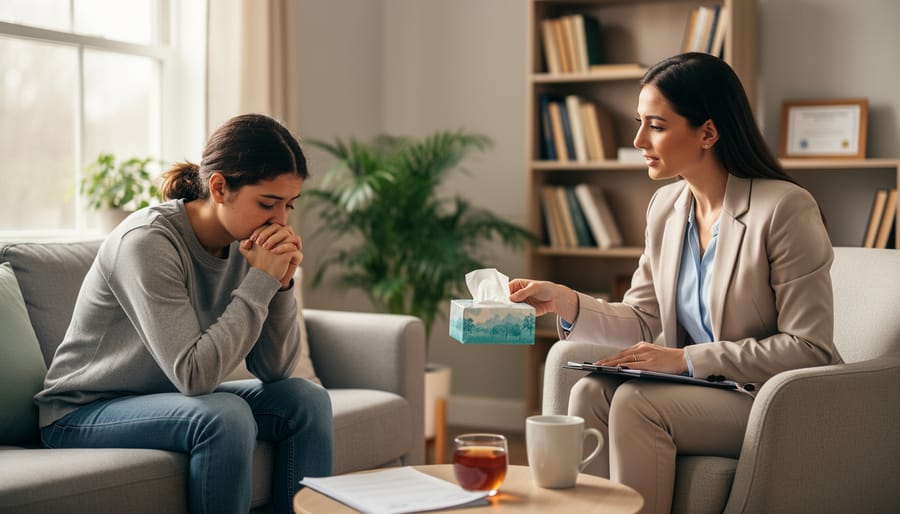 The image emphasizes compassionate support, showing that reaching out for professional help is a stabilizing step during anxiety.
When to Seek Professional Support
The self-help techniques covered in this article can be remarkably effective, but sometimes anxiety needs more support than strategies you practice alone. Understanding the difference between normal vs abnormal anxiety helps you recognize when it’s time to reach out for professional care.
Consider seeking support if your anxiety persists despite consistent practice of relief techniques, if it interferes with work, relationships, or daily activities, or if you’re avoiding situations that matter to you. Physical symptoms like chest pain, difficulty breathing, or severe panic attacks that feel unmanageable warrant professional evaluation. If you’re using alcohol, drugs, or other substances to cope with anxious feelings, that’s a clear signal to connect with a mental health professional.
You might also benefit from clinical support if you’re experiencing intrusive thoughts you can’t shake, if anxiety is affecting your sleep for weeks at a time, or if you’re feeling hopeless or overwhelmed to the point where it’s hard to function. These aren’t signs of failure, they’re indicators that your anxiety has reached a level where professional guidance will make the recovery process more effective and sustainable.
Note: If you’re in crisis, you can reach the Canada Suicide Prevention Service 24/7 by calling 1-833-456-4566 or texting 45645.
In Canada, you have several pathways to professional support. Start with your family doctor, who can provide referrals to psychologists, psychiatrists, or counselors. Many provinces offer telehealth services and community mental health centers with sliding-scale fees. Employee assistance programs through your workplace typically include free confidential counseling sessions.
Seeking help isn’t admitting defeat, it’s taking informed action based on what mental health professionals know works. Just as you’d see a doctor for a persistent physical injury, anxiety that doesn’t respond to self-help deserves expert care. The techniques in this article remain valuable as part of professional treatment; therapists often incorporate these same evidence-based strategies into comprehensive care plans tailored to your specific needs.
Living with anxiety is exhausting, and if you’re reading this, you’ve already taken an important step. Recognizing that you need relief and actively seeking solutions shows strength, not weakness.
The five techniques we’ve covered aren’t trendy wellness hacks, they’re evidence-based strategies that Canadian mental health professionals recommend because they work. You don’t need special equipment, expensive programs, or months of training. Whether it’s challenging a worried thought, relaxing tense shoulders, naming what you see around you, taking a slow breath, or accepting that anxiety doesn’t define you, each approach offers real relief you can access right now.
Start small. Pick one technique from this article and try it today. Maybe it’s box breathing before your next meeting, or the 5-4-3-2-1 grounding method when you feel panic rising. Give yourself permission to experiment and find what resonates with you.
You’re not alone in this. Thousands of Canadians manage anxiety successfully using these same approaches, and support is available when you need it. Mental Health Support remains committed to providing accessible resources, evidence-based information, and connection to professional care for everyone navigating mental health challenges.
Your journey with anxiety doesn’t end here. It continues with each small, intentional step you take toward feeling better. You’ve got this.