Your chest tightens. Your thoughts race. That familiar wave of panic starts to rise, and you need something that works right now, not in twenty minutes after deep breathing exercises or a meditation app loads.
The 3-3-3 rule offers exactly that: a simple grounding technique you can use anywhere, anytime, without anyone noticing. It pulls your mind out of anxious spiraling by anchoring you firmly in the present moment through your senses.
Here’s what makes it different from other anxiety tools you might have tried. It doesn’t require apps, special breathing patterns, or a quiet space. You can do it during a presentation, on a crowded subway, or in the middle of a difficult conversation. The simplicity is the strength.
The technique works by interrupting your brain’s anxiety loop. When panic takes over, your mind either races ahead to catastrophic “what-ifs” or replays past worries on repeat. This sensory-based approach forces your attention back to what’s actually happening around you right now, breaking that mental pattern before it spirals further.
Sarah, a teacher from Portland, describes her first experience with the rule: “I was about to walk into a parent conference that had me completely panicked. I stopped in the hallway, looked around, and quietly went through the steps. By the time I opened that door, my hands had stopped shaking and I could think clearly again.”
The 3-3-3 rule isn’t a cure for anxiety disorders, and it won’t replace professional treatment if you need it. But it’s a practical tool that puts immediate relief in your hands when anxiety strikes. Whether you’re managing diagnosed anxiety or dealing with everyday stress, learning this technique gives you one more way to take back control when your mind tries to convince you there is none.
What Is the 3-3-3 Rule for Anxiety?
The 3-3-3 rule is a straightforward grounding technique that pulls your attention away from anxious thoughts and anchors it in the present moment. When anxiety hits, you follow three simple steps: name three things you can see around you, identify three sounds you can hear, and move three parts of your body. That’s it.
Note: The 3-3-3 rule steps are: 1) Name 3 things you see, 2) Identify 3 sounds you hear, 3) Move 3 body parts.
This 333 rule for anxiety works because it interrupts the spiral of worried thoughts by redirecting your brain to focus on concrete sensory information. Instead of ruminating on “what if” scenarios or physical anxiety symptoms, you’re actively engaging with your immediate environment. The visual component might include noticing a picture frame on the wall, the pattern on your shirt, or a tree outside the window. For sounds, you tune in to background noise you’d normally filter out: the hum of air conditioning, distant traffic, your own breathing. The movement piece brings awareness to your body in a controlled way, wiggling your toes, rotating your shoulders, clenching and releasing your fists.
The beauty of this method is that it requires no special equipment, no quiet space, and no prior experience with meditation or anxiety 101 concepts. You can use it anywhere, anytime anxiety strikes. That accessibility is exactly why the 3-3-3 rule has gained significant traction in 2026 as one of the most recommended grounding techniques. Grounding methods that focus on sight, sound, and touch help calm overwhelming feelings by bringing your nervous system back to the here and now rather than the imagined future your anxiety wants you to worry about.
Unlike breathing exercises that some people find counterintuitive during panic, or visualization techniques that require concentration many anxious minds struggle to muster, the 3-3-3 rule gives you concrete external tasks. You’re not trying to control your thoughts or force yourself to relax, you’re simply noticing what’s already around you.
How the 3-3-3 Rule Actually Works in Your Brain
When anxiety takes hold, your brain shifts into threat-detection mode. Your amygdala, the part of your brain that processes fear, fires signals faster than your rational mind can keep up. Heart racing, thoughts spiraling, breath shallow. You’re stuck in a loop where worry feeds more worry.
The 3-3-3 rule interrupts this loop by pulling your brain’s attention away from perceived threats and anchoring it to what’s actually happening right now. When you deliberately focus on naming three things you see, three sounds you hear, and moving three body parts, you’re activating different neural pathways, ones connected to observation and sensory processing rather than fear response.
Think of it like changing the channel. Your anxious thoughts are running on one frequency, looping through worst-case scenarios and “what ifs.” By shifting your focus to concrete sensory information, the texture of the chair beneath you, the hum of the refrigerator, the movement of your fingers, you’re essentially switching to a different broadcast. Your brain can’t fully process both channels at once.
This technique works because it engages your prefrontal cortex, the rational part of your brain responsible for present-moment awareness and decision-making. When you’re counting sounds or identifying objects, you’re giving this region something specific to do, which helps regulate the emotional response happening deeper in your brain.
Grounding techniques that focus on sight, sound, and touch help you find calm when you feel overwhelmed because they’re immediate and require no equipment, no preparation, no explanation to anyone around you. You’re tapping into what’s already available: your senses and your surroundings.
The physical movement component matters too. When you wiggle your toes, roll your shoulders, or tap your fingers, you’re creating a feedback loop between your body and brain. These small, controlled movements send signals that you’re safe and in control, contradicting the panic signals your amygdala is broadcasting.
This isn’t about positive thinking or forcing yourself to relax. It’s about grounding to refocus your attention on verifiable reality instead of the catastrophic predictions anxiety generates. You’re not fighting the anxiety, you’re redirecting your mental resources toward something your brain can actually verify and manage.
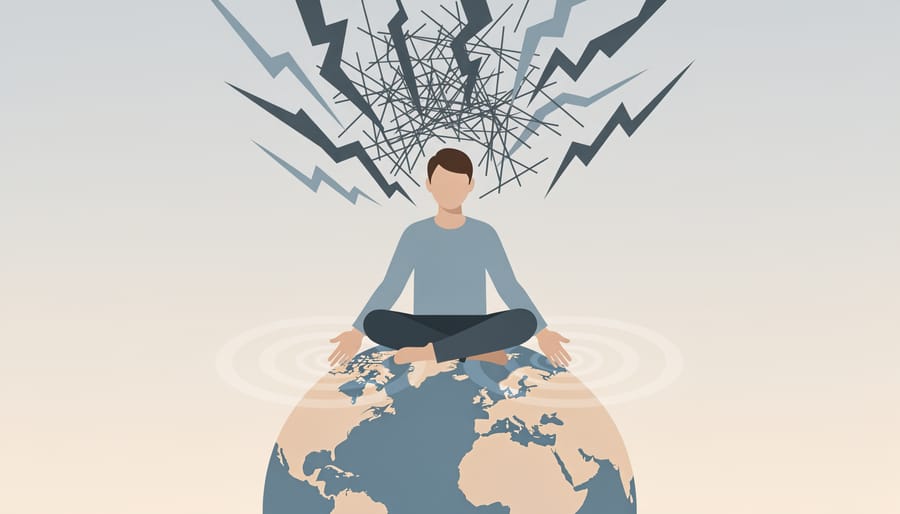 When anxiety feels loud, grounding through sensory awareness can help you reconnect to what’s real right now, like the feel of the world beneath you.
Using the 3-3-3 Rule During an Acute Anxiety Episode
When You’re in Public Spaces
Public spaces present their own challenge: you need relief, but you don’t want to look like you’re having a meltdown in the middle of a meeting or on a crowded train. The good news is that the 3-3-3 rule works just as well when practiced quietly and subtly.
Start with your visual scan naturally, as though you’re simply observing your surroundings. Notice three things in your field of view: the clock on the wall, someone’s jacket, the pattern on the floor. You’re not staring, just looking. For sounds, you don’t need silence. Listen for the hum of the air conditioner, distant conversations, or traffic outside. These become your anchors.
The movement component needs discretion. Instead of large gestures, use micro-movements that feel private. Tap your fingers against your thumb one at a time, flex your toes inside your shoes, or roll your shoulders slightly as if adjusting your posture. In a meeting, you can press your feet into the floor, rotate your ankles, or squeeze and release your hands under the table.
Many people dealing with workplace anxiety find that keeping a small object in their pocket helps. A smooth stone, a pen, or even car keys can serve as a tactile focus point during the movement phase without drawing attention. The key is remembering that grounding doesn’t require space or privacy. It requires only your willingness to redirect your attention, right where you are.
 In public or work settings, returning to simple sensory details can make anxiety feel more manageable and less overwhelming.
 A grounded moment at home can help bring attention away from anxious thoughts and back to the body and senses.
When You’re Alone at Home
When you’re managing anxiety at home you have the freedom to fully engage with the 3-3-3 rule without worrying about appearances. This privacy lets you maximize the technique’s calming effect.
Start by saying the three things you see out loud rather than just thinking them. “I see the blue coffee mug on the table. I see the crack in the ceiling. I see sunlight coming through the window.” Vocalizing activates different neural pathways and keeps your mind from wandering back to anxious thoughts.
For the sounds portion, close your eyes if it helps you focus. You might notice the hum of your refrigerator, birds outside, or the creak of your house settling. Naming these sounds anchors you in the present moment.
The movement section offers the most flexibility at home. Instead of subtle finger tapping, try bigger movements: roll your shoulders back three times, touch your toes three times, or clench and release your fists. Physical engagement helps discharge the tension that builds during anxiety episodes. You can even combine movements, like standing up and sitting down three times while maintaining your focus on sensory details.
The 3-3-3 Rule for Kids and Young People
Children often struggle to articulate what anxiety feels like or understand abstract coping instructions like “calm down” or “think positive thoughts.” The 3-3-3 rule gives them something concrete to do with their bodies and minds when worrying thoughts take over. Because it relies on simple observation and movement rather than complex emotional regulation, it’s particularly effective for people of all ages including young children who are just beginning to recognize their anxiety symptoms.
For younger children (ages 4-8), you’ll want to make the technique playful and engaging. Instead of asking them to “name three things you see,” try “let’s play the spy game, tell me three things a spy would notice in this room right now.” Encourage them to point at each item or touch it if possible. With sounds, you might say “put on your superhero ears, what are three sounds you can hear?” The body movement portion often works best as an invitation: “show me three different ways you can wiggle your body.” Kids naturally love wiggling their fingers, shaking their shoulders, or stomping their feet, which makes this part intuitive.
Older children and teenagers (ages 9-17) can grasp the technique more directly and often appreciate understanding why it works. Explain that their brain gets stuck in worry mode, and this exercise is like pressing a reset button. Teens particularly benefit from knowing they can use it discreetly at school, during tests, or in social situations without anyone noticing. They might silently observe three things while looking around a classroom, internally note three sounds, and subtly move their toes, clench and release their fists, or roll their shoulders.
Tip: Practice the 3-3-3 rule with your child during relaxed moments, at breakfast, during car rides, or before bed, so it becomes familiar and automatic when anxiety actually strikes.
Sarah, a primary school teacher in Melbourne, started teaching the technique to her Year 3 class in early 2026 after noticing increased anxiety around test days. “One of my students, an eight-year-old girl who would freeze up during maths assessments, now uses it every time,” Sarah shares. “She looks around the room, listens carefully, then wiggles her fingers under her desk. By the time she’s done, I can see her shoulders relax and she picks up her pencil again. It’s given her something she can control when everything else feels overwhelming.”
The beauty of this technique for young people is that it doesn’t require them to talk about their feelings before they’re ready, doesn’t need any special equipment, and can be done anywhere. Whether it’s separation anxiety at drop-off, social worries at recess, performance anxiety before a presentation, or the general overwhelm that many young people face in 2026, having this tangible tool helps them feel less powerless in the face of anxiety.
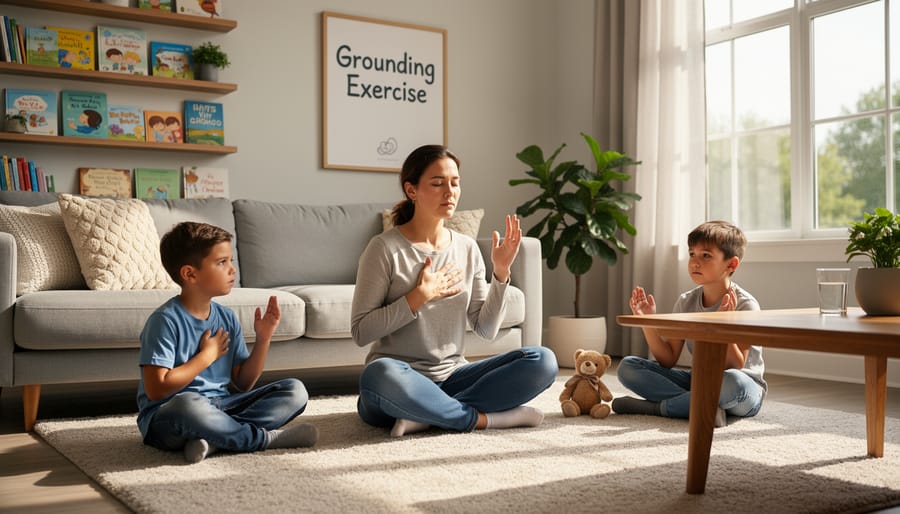 A grounding exercise can be taught and practiced with kids in everyday, calm moments, so it’s easier to use during anxiety.
Combining the 3-3-3 Rule with Other Anxiety Management Strategies
The 3-3-3 rule works best when it’s part of a larger anxiety management approach, not a standalone fix. Think of it as one reliable tool in your mental health toolkit, ready when you need quick grounding but working alongside other strategies that address anxiety from different angles.
Pairing the 3-3-3 rule with controlled breathing creates a powerful combination. When anxiety hits, start with the grounding technique to interrupt the spiral, then move into slow, deep breaths to calm your nervous system further. Many people find that grounding first makes breathing exercises easier because they’ve already shifted their focus away from anxious thoughts.
Therapy remains foundational for understanding and managing anxiety long-term. Whether you’re working with a counselor on cognitive behavioral techniques or exploring underlying triggers, the 3-3-3 rule gives you something concrete to practice between sessions. It reinforces the present-moment awareness that many therapeutic approaches teach, making it a practical extension of professional support.
For those managing anxiety with medication, grounding techniques like the 3-3-3 rule offer immediate relief while medication works in the background. They’re not replacements for prescribed treatment but complementary tools that give you agency during acute episodes. The same goes for lifestyle changes: regular exercise, good sleep, and limiting caffeine all reduce baseline anxiety, while the 3-3-3 rule helps when breakthrough symptoms appear despite your healthy habits.
Other grounding techniques that focus on sight, sound, taste, and touch can help you find calm when you feel overwhelmed. If the 3-3-3 rule doesn’t resonate with you, try the 5-4-3-2-1 method, holding ice cubes, or focusing on physical sensations. Different situations call for different tools.
The key is building a personalized approach. You might use the 3-3-3 rule for panic attacks, breathing exercises before stressful meetings, therapy to work through deeper issues, and daily meditation to maintain baseline calm. None of these strategies works in isolation, but together they create a sustainable way to manage anxiety that fits your real life.
What to Do When the 3-3-3 Rule Isn’t Enough
Sometimes the 3-3-3 rule brings instant relief, and sometimes it doesn’t. That’s not a failure on your part. When anxiety persists despite trying grounding techniques, or when it’s starting to interfere with your daily life, work, relationships, or sleep, it might be time to reach out for professional support. Understanding the difference between normal vs abnormal anxiety can help you recognize when what you’re experiencing has moved beyond everyday stress.
Note: If you’re experiencing thoughts of self-harm, severe panic that won’t subside, or feel like you’re in crisis, contact a mental health crisis line or emergency services immediately, this is when you need real-time support, not a self-help technique.
Professional support doesn’t mean the 3-3-3 rule failed you. It means your anxiety needs additional tools and expert guidance. A therapist can help you develop a personalized anxiety management plan that might include cognitive behavioral therapy, medication, or other evidence-based approaches tailored to your specific situation. Mental Health Support offers both digital platforms and face-to-face options that connect you with professionals who understand what you’re going through.
If the 3-3-3 rule isn’t clicking for you, try other grounding alternatives. Some people find box breathing (inhaling for four counts, holding, exhaling, holding) more effective. Others prefer the 5-4-3-2-1 technique, which adds taste and smell to the sensory engagement. Physical grounding like holding ice cubes, pressing your feet firmly into the floor, or progressive muscle relaxation works better for certain people. The goal is finding what actually helps you, not forcing yourself into a technique that doesn’t fit your needs.
Real Stories: How People Are Using the 3-3-3 Rule in 2026
Sarah, a 34-year-old teacher from Melbourne, first tried the 3-3-3 rule during a morning staff meeting when her chest started tightening. She discreetly looked around the room, naming three things she could see: the projector screen, a colleague’s coffee mug, the clock on the wall. Then she tuned into sounds, the air conditioning hum, someone typing, a chair scraping. Finally, she wiggled her toes, rolled her shoulders back, and flexed her fingers under the table. “Within two minutes, I could breathe normally again,” she says. “No one even noticed I was doing it.”
Marcus, 17, keeps the 3-3-3 rule in his back pocket for exam anxiety. He’s been practising it since his school counsellor taught it to him earlier this year. “I used to freeze up completely during tests,” he explains. “Now I do a quick cycle, look at my pencil, the corner of my desk, the window. Listen for the clock, someone coughing, the air vent. Tap my feet three times, stretch my neck, clench my fists. It’s like hitting reset.”
For Jamie, a parent of two young kids, the technique has become a family practice. “My six-year-old gets overwhelmed at bedtime, so we do it together,” Jamie shares. “We name three stuffed animals we can see, three sounds outside her window, and she touches her nose, ears, and toes. It’s become our calm-down routine, and honestly, it helps me as much as it helps her.”
The growing awareness around grounding techniques has led to more structured support in 2026. Community workshops focused on managing stress and anxiety now regularly feature the 3-3-3 rule alongside other mindfulness practices, giving people safe spaces to learn and practice these tools together.
What stands out across these stories is consistency. People who practice the rule during calm moments find it more accessible when panic actually strikes. Elena, who’s been using it for six months, puts it simply: “I don’t wait for the anxiety to hit anymore. I do a quick 3-3-3 when I’m waiting for the kettle to boil, standing in line, walking to my car. It’s become automatic now, so when I really need it, my brain already knows what to do.”
You’re not alone in this. Millions of people wake up every day managing anxiety, and the fact that you’re here, learning about tools like the 3-3-3 rule, shows real strength.
Here’s something important: the 3-3-3 rule works best when you practice it before you need it. Try it tomorrow morning with your coffee, or while you’re waiting for the bus. When your brain isn’t flooded with stress hormones, you’re building neural pathways that will be there when anxiety does strike. Think of it like a fire drill for your nervous system.
No single technique will solve everything, and that’s okay. Some days the 3-3-3 rule will bring you back in seconds. Other days, you’ll need to combine it with breathing exercises, reach out to someone who gets it, or seek professional support. All of those responses are valid.
If you’re struggling right now and need someone to talk to, Mental Health Support offers both digital and face-to-face options. You can connect with trained professionals who understand what you’re going through, or join community groups where people share grounding techniques and real experiences.
Your anxiety doesn’t define you. It’s something you’re learning to manage, one breath and one grounded moment at a time. You’ve already taken the first step by being here.