When someone you care about shows signs of a mental health crisis, knowing what to say or do in those first critical moments can mean everything. Mental Health First Aid Canada gives ordinary people the skills to recognize when someone is struggling, respond with confidence instead of panic, and connect them to professional help before a situation escalates.
Since 2006, this national program has trained over 500,000 Canadians to support friends, family members, coworkers, and strangers facing mental health challenges or substance use concerns. Unlike standard first aid, which prepares you to handle physical emergencies, this training focuses on psychological crises: severe anxiety attacks, suicidal thinking, psychosis, substance overdoses, and trauma responses.
The program was developed by the Mental Health Commission of Canada, the same organization that created national workplace standards and anti-stigma campaigns. It’s evidence-based, continuously updated, and recognized by employers, schools, and healthcare organizations across the country.
Sarah, a high school teacher from Halifax, describes the moment her training clicked: “A student came to me having a panic attack, and instead of freezing or saying the wrong thing, I actually knew how to help. I recognized the signs, stayed calm, and used the exact steps I’d learned. That student later told me I was the first person who made them feel safe enough to ask for help.”
The certification isn’t just for professionals. Parents learn to spot early warning signs in their teenagers. Managers discover how to start difficult conversations with struggling employees. Friends gain the language to check in without making things worse.
If you’ve ever felt helpless watching someone suffer, or worried you’d say the wrong thing during a crisis, this training addresses exactly that gap. You’ll learn practical intervention techniques that work in real situations, not theoretical concepts that sound good on paper.
 A quiet moment of support shows how staying present can help someone feel less alone during a mental health crisis.
What Mental Health First Aid Canada Actually Is
Mental Health First Aid Canada is a national program designed to teach everyday people how to recognize and respond to mental health challenges in their communities. Established in 2006 through a partnership with the Mental Health Commission of Canada, it’s built on a simple but powerful idea: just as we learn CPR to help during a physical health emergency, we can learn skills to support someone experiencing a mental health crisis or developing a mental health problem.
Here’s what it isn’t: MHFA Canada doesn’t train you to become a therapist or diagnose conditions. You won’t leave certified to provide ongoing treatment. Instead, think of it as the mental health equivalent of physical first aid, you’re learning to be the person who steps in during those crucial early moments, offering support until professional help takes over.
The program teaches you to spot warning signs that someone might be struggling, whether that’s a colleague showing signs of burnout, a family member experiencing depression, or a friend in acute distress. You learn practical skills for approaching someone with empathy, listening without judgment, and guiding them toward appropriate professional resources. It’s about bridging that gap between when someone first shows signs of struggle and when they access formal care.
One common misconception is that you need a medical or counseling background to take the training. You don’t. MHFA courses are designed for adults 18 and older who interact with other adults in any setting, workplaces, schools, community groups, or just everyday life. The program now offers official certification, giving participants recognized credentials that demonstrate their commitment to mental health literacy.
What makes this training particularly valuable in 2026 is how it normalizes mental health conversations and reduces stigma. You’re not just learning skills; you’re becoming part of a movement that treats mental health with the same seriousness and compassion we extend to physical health.
The Three Ways You Can Get Certified
When you decide to get trained in Mental Health First Aid, you’ll choose from three distinct course types, each tailored to different needs and circumstances. All three programs lead to official certification, marking a significant shift in how mental health education is recognized across Canada.
The basic Adult Mental Health First Aid course forms the foundation. It’s designed for adults interacting with other adults aged 18 and older, teaching you to recognize signs of mental health challenges in your peers, colleagues, family members, and community. This course covers a broad spectrum of situations, from supporting someone experiencing dentist anxiety that escalates into panic to recognizing early warning signs of depression or substance use concerns. You’ll learn the ALGEE action plan and gain confidence in providing that crucial initial support before professional help arrives.
| Course Type |
Who It’s For |
Format Options |
Certification |
| Adult MHFA |
Adults helping adults 18+ |
In-person, virtual, blended |
Official certification available |
| Youth-Focused MHFA |
Adults working with young people |
In-person, virtual, blended |
Official certification available |
| Specialized Workplace MHFA |
Employers, managers, HR professionals |
In-person, virtual, blended |
Official certification available |
The second option focuses on youth mental health, equipping adults who work with or care for young people. Teachers, coaches, youth leaders, and parents often choose this course because it addresses the unique ways mental health challenges present in adolescents and young adults. The training acknowledges that signs of distress look different in a 15-year-old than in a 45-year-old.
Finally, specialized workplace courses adapt the core MHFA principles to professional settings. These programs help managers and colleagues create mentally healthier work environments, recognize burnout and stress in team members, and respond effectively without overstepping boundaries or making assumptions about someone’s private struggles.
Each course now offers multiple delivery formats in 2026. You can attend in person for the full immersive experience, join virtual sessions that fit your schedule, or opt for blended learning that combines self-paced online modules with live interactive components. The certification you earn is the same regardless of format, officially recognized through the Mental Health Commission of Canada’s partnership with MHFA Canada, which has been developing these programs since 2006.
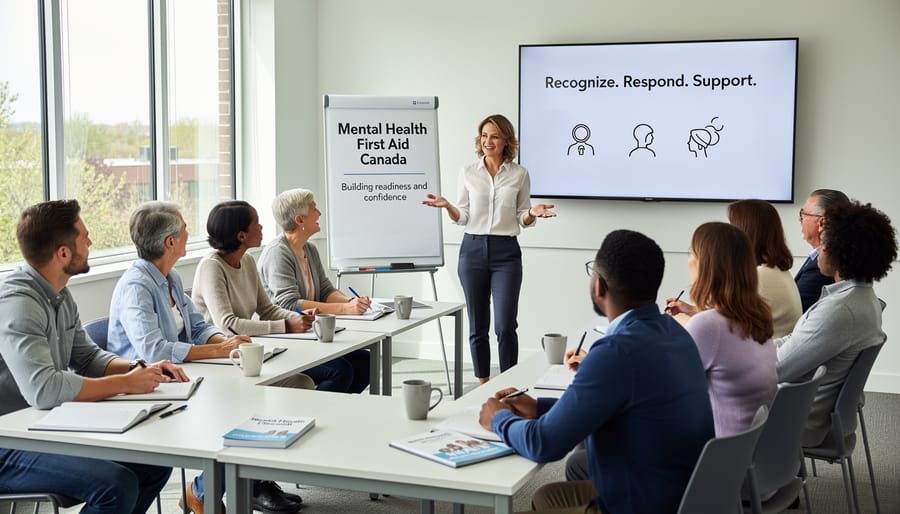 This training-room scene reflects how Mental Health First Aid Canada helps everyday people build readiness and confidence.
Real Stories: When Mental Health First Aid Made the Difference
Sara had noticed her 16-year-old son pulling away for months. He’d stopped going to basketball practice, barely touched his dinner, and spent hours alone in his room. She’d chalked it up to typical teenage moodiness until the MHFA course taught her to recognize the pattern: persistent withdrawal, changes in eating habits, loss of interest in activities he once loved. These weren’t just phases. They were warning signs.
“The training gave me permission to have that conversation I’d been avoiding,” Sara says. “I approached him without judgment, told him what I’d noticed, and just listened. Really listened, without trying to fix everything immediately.” Her son opened up about feeling worthless and exhausted all the time. Instead of panicking or dismissing his feelings, Sara used what she’d learned. She validated his experience, helped him understand he wasn’t alone, and together they reached out to their family doctor the next day. “MHFA didn’t make me a therapist. It made me a parent who knew how to be present in the scariest moment of my life.”
Marcus never expected he’d need mental health skills at his accounting firm. Then his colleague James started missing deadlines, snapping at teammates, and looking visibly shaken during meetings. Most people avoided him. Marcus recognized anxiety at home from his own family’s experience, but workplace anxiety looked different. After his MHFA training, he felt equipped to check in.
He caught James after work one day. “Hey, I’ve noticed you seem stressed lately. Want to grab coffee?” That simple opening led to James sharing that he’d been having panic attacks and didn’t know what to do. Marcus didn’t try to counsel him, but he did listen, share information about the employee assistance program, and follow up the next week. James got help. Their team got stronger. “I didn’t save his life,” Marcus says. “I just showed up when it mattered.”
These moments happen quietly, in living rooms and office hallways, because someone learned to recognize pain and respond with confidence instead of fear. That’s the real difference MHFA makes.
What You’ll Actually Learn in the Course
The Mental Health First Aid course isn’t about diagnosing mental illness or replacing professional therapists. Think of it more like learning CPR for the mind, practical skills that help you support someone in distress until they can access appropriate care.
At the heart of the training is the ALGEE action plan, a five-step framework that makes responding to mental health situations feel less overwhelming. ALGEE stands for: Approach the person and assess their needs, Listen without judgment, Give support and information, Encourage professional help, and Encourage self-help strategies. You’ll practice each step through realistic scenarios, learning how to have difficult conversations with confidence rather than fear.
Before you can offer help, though, you need to spot the signs. The course teaches you to recognize early warning signals across a range of mental health challenges, depression, anxiety disorders, psychosis, substance use issues, and trauma responses. You’ll learn to distinguish between normal vs abnormal reactions to stress, and when someone might need immediate support.
Crisis situations get dedicated attention. You’ll learn specific protocols for supporting someone experiencing suicidal thoughts, panic attacks, or acute psychotic episodes. These sections are taught with sensitivity and practical guidance, preparing you to stay calm and helpful when someone’s safety is at stake.
The training covers skills like:
- Recognize early signs that someone’s mental health may be declining
- Start supportive conversations without making assumptions or offering quick fixes
- Provide reassurance and practical information about resources
- Guide someone toward professional help without forcing or shaming them
- Respond safely and effectively in crisis situations
- Maintain appropriate boundaries while offering support
What surprised many past participants is how much time the course spends on understanding stigma, both the external kind that stops people from seeking help, and the internalized shame that can make mental health challenges feel isolating. You’ll examine your own beliefs and learn language that supports rather than marginalizes.
Finally, the course emphasizes self-care for helpers. Supporting someone through mental health struggles can be emotionally demanding. You’ll learn to recognize your own limits, manage secondary stress, and protect your wellbeing while showing up for others. This isn’t selfish, it’s essential for sustainable support.
 The glowing light symbolizes compassionate, immediate support, bridging the gap until professional help arrives.
Who Should Consider Taking This Training
You don’t need a psychology degree or healthcare background to learn these skills. The training is designed for any adult over 18 who wants to be better prepared to support someone in emotional pain. It’s for the people already in positions of care and influence, and for those who simply want to show up differently when it matters.
Parents find this training especially valuable. When your teenager withdraws to their room for days or your young adult child mentions feeling hopeless, recognizing these signs early can change the outcome. The same applies to teachers who notice a shift in a student’s behaviour or engagement, giving them concrete ways to approach difficult conversations without crossing professional boundaries.
Workplace leaders and managers increasingly recognize that supporting team members dealing with workplace anxiety depression, or stress isn’t just compassionate, it’s essential. This training equips them to respond thoughtfully rather than avoiding these situations altogether. Community leaders, faith group facilitators, and volunteers who work with vulnerable populations gain confidence in handling crises they may have previously felt unprepared for.
Healthcare workers, even those outside mental health specialties, benefit from structured approaches to mental health conversations. Front-line staff in emergency services, social work, and education often encounter people in distress but may lack formal training in this specific area.
Here’s the truth: mental health challenges don’t discriminate, and they don’t only appear during office hours or in clinical settings. They show up at family dinners, in locker rooms, during late-night texts from friends. Mental health literacy matters because we all exist in a web of relationships where someone might need us. Being prepared to recognize struggle and respond with compassion isn’t a specialized skill reserved for professionals. It’s a form of care we can all offer.
How to Get Started with MHFA Canada
Getting started is straightforward. Visit the Mental Health Commission of Canada’s official website to explore current course offerings and find instructors in your area. You can search by location, course type, and delivery format, whether you prefer in-person sessions or the flexibility of online learning. Most courses run 12-14 hours total, typically spread across two full days or several evening sessions, making them accessible even with busy schedules.
Tip: Check with your employer, school, or local community organization, many sponsor or subsidize MHFA training for staff, students, or members at reduced or no cost.
Once you complete the training, you’ll receive official certification that demonstrates your competency in mental health first aid principles. The Mental Health Commission of Canada partners with various training providers across the country, so course fees and specific schedules vary by region and instructor. You don’t need any prerequisites or medical background to enroll, just a commitment to learning. If you’re uncertain which course type fits your needs, whether you’ll be working with youth, adults, or specific populations dealing with challenges like Anxiety 101 most providers offer guidance to help you choose. Registration typically happens online through your chosen provider’s portal, and you’ll receive materials before your first session begins.
When someone you care about is struggling, the question isn’t whether you should help. It’s whether you’ll know how. Mental Health First Aid Canada exists because we all deserve to be surrounded by people who can show up with both compassion and confidence when mental health challenges arise.
Taking this training is more than earning a certification. It’s choosing to be the person who notices, who listens without judgment, who stays calm when someone else can’t. It’s an investment in your family, your workplace, and your community. Every person trained creates a ripple effect of support that extends far beyond a single crisis moment.
Whether you’re a parent wanting to better understand your teenager, a manager hoping to create a psychologically safer workplace, or simply someone who wants to be there for the people around you, this training meets you where you are. You don’t need a medical background or special expertise. You just need to care enough to learn.
If you’re ready to take the next step, visit the Mental Health Commission of Canada’s website to explore course options in your area. Share this information with colleagues, friends, or family members who might benefit. Every conversation we start about mental health makes it easier for the next person to ask for help.
And if you or someone you know needs support right now, remember that real-time crisis resources are available 24/7 through organizations across Canada. You’re not alone in this.