Your body knows you’re anxious before your mind catches up. Physical signs of anxiety include a racing or pounding heart, chest tightness, shallow breathing, muscle tension, sweating, dizziness, dry mouth, stomach upset, and fatigue. Learning to recognize these sensations as anxiety, not a medical emergency or random discomfort, gives you the power to respond with grounding techniques instead of spiraling into panic.
Most people experience anxiety as a physical event first. You might notice your heart hammering during a work presentation, your stomach churning before a difficult conversation, or your muscles tensing when scrolling through stressful news. These reactions are your nervous system’s way of preparing you for perceived threats, real or imagined. The challenge is distinguishing between normal anxiety that passes once the stressor is gone and problematic anxiety that shows up uninvited, lingers too long, or interferes with daily life.
When anxiety becomes disproportionate to the situation, happens frequently without clear triggers, or feels impossible to manage, your body is signaling that you need additional support. Understanding what your specific anxiety symptoms look like and how to verify they’re anxiety-related rather than another health concern is the first step toward regaining control. You’re not imagining these sensations, and you’re not alone in experiencing them.
Key Takeaway: Normal anxiety is situation-specific, proportional to the actual stressor, and fades when the situation passes. Anxiety disorders involve symptoms that appear frequently without clear danger, feel extreme and difficult to control, persist long after stress ends, and significantly interfere with your daily life and well-being.
What Your Body Does When Anxiety Strikes
 A quiet moment shows how anxiety can feel physical, with tension and discomfort appearing in posture and breathing.
When anxiety kicks in, your body launches a sophisticated alert system designed to protect you, even when the threat is a work presentation rather than a physical danger. This response isn’t random; it’s your nervous system doing exactly what evolution programmed it to do.
Your heart might pound or race, sometimes so hard you feel it in your throat. Chest tightness can make it feel like there’s a band around your ribs. You might notice your breathing becomes quick and shallow, or you can’t quite catch a full breath. These cardiovascular and respiratory changes happen because your body is preparing to fight or flee, pumping oxygen to your muscles and brain.
The physical anxiety symptoms you experience often cluster in predictable patterns:
- Cardiovascular: racing heart, pounding pulse, chest tightness or pressure
- Respiratory: shallow breathing, shortness of breath, feeling like you can’t get enough air
- Muscular: tension in shoulders, neck, or jaw; trembling or shaking; overall fatigue
- Digestive: nausea, stomach aches, butterflies, diarrhea or other GI upset
- Neurological: dizziness or lightheadedness, dry mouth, sweating
Here’s what matters: these sensations are information, not damage. Your body is talking to you, sending signals about stress or perceived threat. A racing heart doesn’t mean your heart is failing. Shallow breathing doesn’t mean you’re suffocating. Stomach upset doesn’t indicate a serious digestive problem.
Think of these symptoms as your body’s native language for communicating stress. The same way hunger tells you to eat, physical anxiety tells you that your nervous system has detected something it thinks requires your attention. Learning to recognize and interpret these signals, rather than fearing them, is the first step toward managing anxiety effectively.
What You Need to Start Recognizing Your Anxiety Signals
 Steam rising from a warm mug can symbolize how anxious energy builds internally even when the mind tries to stay calm.
You don’t need expensive apps or specialized equipment to start reading your body’s anxiety signals, just a willingness to pay attention and a few simple practices. The most powerful tool is a basic body-scan approach: pause several times throughout your day and mentally check in from head to toe, noticing tension in your jaw, tightness in your chest, or that knot in your stomach. You’re learning what your body feels like when it’s calm versus when anxiety is building.
Tip: You don’t need special equipment, just honest self-observation and a willingness to pause when physical sensations show up.
Keep a simple record, whether that’s notes on your phone or a dedicated journal. Jot down what you notice physically and what was happening at the time, this pattern tracking helps you connect the dots between situations and symptoms. Understanding your personal baseline matters too. Everyone’s stress response looks different, so spend a week observing how your body typically reacts to normal stressors like a work deadline or a minor conflict. This gives you a reference point.
Finally, learn the distinction between normal and problematic anxiety. Normal anxiety responds to a specific situation, feels proportional to what’s happening, and fades when the stressor passes. Problematic anxiety is much stronger, lasts longer after the event, comes up when you aren’t actually in danger, and becomes hard to manage. Knowing this difference helps you recognize when physical symptoms are your body handling everyday stress versus signaling something that needs attention.
When Physical Symptoms Become Warning Signs
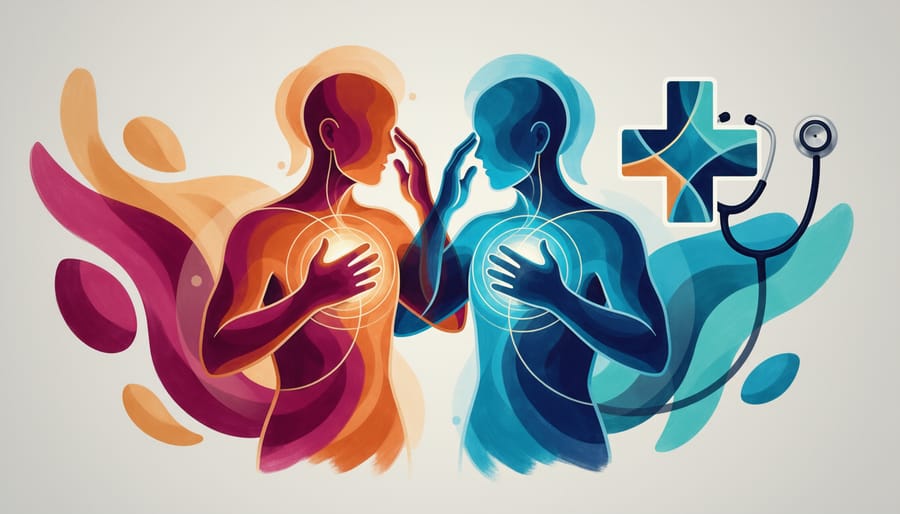 The image captures the idea of checking physical signals thoughtfully, balancing self-awareness with knowing when to seek medical help.
Sometimes your body’s anxiety signals are actually urgent medical warnings in disguise. While anxiety can cause uncomfortable physical sensations, certain symptoms require immediate medical attention, and confusing the two can be dangerous.
Chest pain is the most critical symptom to evaluate carefully. Anxiety and panic attacks can cause chest tightness, pressure, or sharp pains that feel genuinely alarming. However, chest pain needs emergency care if it’s crushing or squeezing, radiates to your jaw, arm, or back, comes with shortness of breath or cold sweats, or doesn’t ease when you try to calm down. Heart attack pain typically builds gradually and feels like pressure rather than sharp jabs. If you’re uncertain, call emergency services, medical professionals would rather evaluate chest pain that turns out to be anxiety than miss a heart attack.
Warning: Call emergency services immediately if you experience severe chest pain with arm or jaw pain, inability to breathe or catch your breath, loss of consciousness or near-fainting, or severe confusion or inability to speak clearly.
Breathing difficulties also need careful assessment. Anxiety often causes rapid, shallow breathing or the sensation you can’t get enough air, but you can usually still speak in full sentences. True respiratory emergencies involve lips or fingernails turning blue, inability to speak more than a few words, or breathing that becomes progressively worse rather than stabilizing. If you know you’re prone to panic attacks, learning how to stop a panic attack can help you manage breathlessness before it escalates.
Trust your instincts. If symptoms feel different from your usual anxiety, come on suddenly without an obvious trigger, or you have an underlying sense that something is seriously wrong, seek medical attention. It’s always safer to have a doctor rule out medical causes, especially if you’re experiencing these physical sensations for the first time.
The Four-Step Process to Read Your Body’s Anxiety Signals
Step 1: Notice Whether Your Symptoms Are Tied to Something Specific
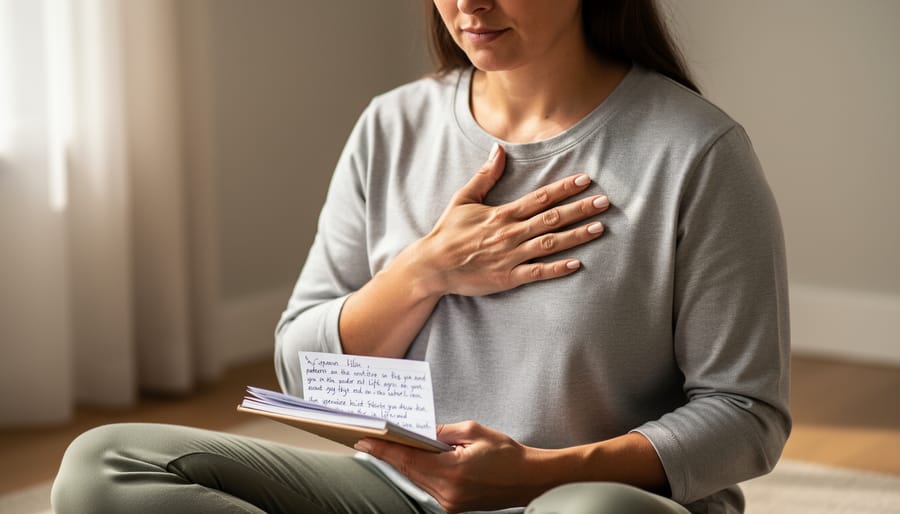 A grounding pause, hand on the body and notes in hand, represents recognizing patterns and responding with self-awareness.
Start by watching what’s happening when your body reacts. For the next few days, every time you notice a physical symptom, that racing heart, the knot in your stomach, the tension across your shoulders, pause and ask yourself what you were doing or thinking about right before it started.
You’re looking for connections. Does your chest tighten every time you open your work email? Does your stomach flip when you’re getting ready for a social event? Does your heart pound before speaking up in meetings? Maybe it’s Sunday evenings before the work week, or the moment you remember an upcoming deadline.
Jot down what you notice. You don’t need a formal journal, notes on your phone work fine. Write the symptom, the situation, and roughly when it happened. After three or four days, you’ll start seeing patterns. You might discover that your body reacts to presentations but not to one-on-one conversations, or that crowded spaces trigger symptoms while small gatherings don’t.
Sometimes the connection is obvious: your heart races as you walk into a room full of strangers. Other times it’s subtler, maybe your jaw clenches every time a certain person texts you, or your breathing gets shallow when you’re running late.
If your symptoms consistently show up around specific situations, that’s useful information. It tells you your body is responding to identifiable stressors, which is actually how normal anxiety works. That pattern becomes your starting point for the next step.
Step 2: Check Whether Your Response Fits the Situation
Once you’ve noticed your body’s physical signals and tied them to a specific trigger, the next step is evaluating whether your reaction makes sense for what you’re facing. This is where you distinguish between your body doing its job and something that might need attention.
Normal anxiety shows up when there’s actually something to worry about. If you’re presenting to your boss tomorrow and your heart’s racing tonight, that’s your body preparing you for a challenge. If you feel chest tightness walking into a job interview, that fits the situation. These reactions are proportional, they match the stakes of what you’re dealing with.
Here’s what to ask yourself: Would most people feel some physical response in this situation? Is there a real challenge or potential consequence ahead? When you compare the intensity of your symptoms to what you’re facing, does it feel reasonable?
Equally important is what happens after. Normal anxiety fades when the stressor passes or you realize the threat wasn’t as big as you thought. Your racing heart slows down after the presentation ends. The stomach butterflies settle once the interview is over. You might feel tired from the stress, but the physical symptoms don’t linger for hours or days.
If your body’s alarm system is firing at full intensity over minor everyday situations, or if symptoms persist long after the moment has passed, that’s a signal worth noting. Understanding the difference between normal vs abnormal anxiety helps you recognize when your physical responses have crossed from helpful to normal vs problematic anxiety that might benefit from support.
Step 3: Assess How Often and When Your Body Reacts
Frequency matters more than you might think. Start by counting how many days in the past two weeks you’ve felt those physical symptoms. Once or twice before a job interview or difficult conversation? That’s your body responding normally. Several times a week, including ordinary Tuesday afternoons when nothing stressful is happening? That pattern suggests something different.
Pay attention to when your body reacts. Normal anxiety shows up around actual challenges, before medical appointments, during conflicts, when facing real deadlines. It fades once the situation resolves. Problematic anxiety appears during routine activities: grocery shopping, watching TV, lying in bed before sleep. Your heart races during tasks you’ve done a hundred times. Your stomach knots up when you’re objectively safe.
Notice how hard it is to calm your symptoms. Can you talk yourself down in ten minutes, or does your racing heart persist for hours? Do breathing exercises help, or does nothing seem to interrupt the physical spiral?
Track whether symptoms are becoming more frequent over time. Anxiety that’s spreading, showing up in more situations, lasting longer, requiring more effort to manage, signals that your body’s alarm system needs recalibration.
If you’re experiencing physical anxiety symptoms several times a week, in situations where you’re not actually in danger, or finding them increasingly difficult to control, your body is telling you this goes beyond normal stress. That’s not weakness. It’s information.
Step 4: Measure the Intensity and Duration
Normal anxiety might make your heart race before a job interview and settle down once you’re a few minutes in. Problematic anxiety keeps your heart pounding for hours afterward, even when you’re home on your couch. That difference in intensity and duration is what Step 4 helps you measure.
Pay attention to how strong your physical symptoms feel compared to the trigger. Does your chest tighten slightly when you’re running late, or does it feel like you can’t breathe? Do you feel a bit shaky before a difficult conversation, or are your hands trembling so badly you can’t hold your phone? Anxiety disorder symptoms are extreme. They’re not just uncomfortable, they’re overwhelming and often feel disproportionate to what’s actually happening.
Duration matters just as much. Normal anxiety is time-limited. It shows up when you need it and fades when the situation passes. If your stomach upset continues for days after a stressful meeting, if muscle tension never fully releases, if you’re exhausted all the time because your body won’t come down from high alert, you’re looking at something beyond typical stress.
The hardest part to measure, but perhaps most telling, is how much control you have. Can you talk yourself down, use breathing exercises, and feel your symptoms ease? Or do they persist no matter what you try? When physical anxiety significantly impacts your quality of life, disrupting sleep, making you avoid activities, affecting work or relationships, that’s your body telling you it needs more support than self-management alone can provide.
How to Know If Your Recognition Process Is Working
You’ll know your recognition process is working when you start catching physical symptoms earlier in their cycle. Instead of feeling overwhelmed by a racing heart that’s been pounding for twenty minutes, you’ll notice the first flutter of tension in your chest and can identify it as anxiety beginning to build. This early awareness gives you time to decide what to do rather than simply reacting.
Another clear sign is your ability to put words to what’s happening. You might tell yourself, “My shoulders are tight and my breathing is shallow, this is my body responding to stress about tomorrow’s meeting.” That simple act of naming connects the physical sensation to its cause, which helps you distinguish between anticipatory anxiety about a real event and symptoms that show up without any clear trigger.
You’ll also start noticing patterns between your lifestyle and your symptoms. You might realize that your heart races more on days when you’ve had three cups of coffee, or that muscle tension spikes after poor sleep. These connections show you’re reading your body accurately and can adjust habits before symptoms intensify. Most importantly, you’ll develop a clearer sense of when your coping strategies are enough and when it’s time to reach out for professional support.
What to Do Next: From Recognition to Action
Now that you can recognize what your body is telling you, it’s time to respond in a way that matches what you’ve discovered.
If your physical symptoms look like normal anxiety, tied to a real stressor, proportional, and resolving once the situation passes, start with lifestyle adjustments that support your nervous system. Prioritize consistent sleep, since fatigue amplifies anxiety’s physical grip. Cut back on caffeine, which mimics and intensifies symptoms like racing heart and jitteriness. Build in regular movement, even short walks, to metabolize stress hormones your body has already released. Practice the body-scan awareness you’ve been using, but add a grounding technique: when symptoms arise, focus on slow exhales longer than your inhales, or press your feet firmly into the floor and notice five things you can see. These aren’t diversions, they’re direct responses to the physical state you’ve learned to identify.
If your symptoms suggest problematic anxiety, showing up often without real danger, feeling much stronger and harder to control, or persisting long after stress has passed, it’s time to document and reach out. Keep a simple log for one to two weeks: date, physical symptoms, context, intensity, duration. This record gives a healthcare provider or therapist concrete patterns to assess rather than a vague sense that something feels off. Schedule an appointment with your doctor to rule out medical causes, then ask for a referral to a therapist who specializes in anxiety disorders. Early intervention makes a significant difference in outcomes.
You don’t have to wait until you’re certain to seek support. Our organization offers digital resources that explain anxiety disorders in plain language, a social media community where others share similar experiences, and real-time support when you need someone now. Reaching out isn’t a sign you’ve failed to manage on your own, it’s recognizing that your body has been communicating clearly, and you’re listening.
Real Stories: Learning to Listen to the Body
Sarah’s racing heart used to wake her at 3 a.m. every Sunday, chest tight as she mentally rehearsed Monday’s team meeting. She noticed the pattern in her journal after three weeks: the symptoms appeared before high-pressure presentations and vanished within an hour of finishing them. “My body was giving me advance warning,” she says. She started practicing grounding techniques the night before presentations, cut her afternoon coffee, and committed to a ten-minute morning walk. Within a month, she still felt nervous before speaking, but her body’s alarm system had quieted to a manageable level.
Marcus’s experience looked different. His heart pounded unpredictably throughout the day, even during routine tasks like grocery shopping or watching television. The tightness in his chest lingered for hours, sometimes entire days, with no clear trigger he could identify. After tracking symptoms for two weeks, he realized they weren’t tied to specific events and weren’t resolving on their own. His doctor confirmed an anxiety disorder. “I kept thinking I should just handle it myself,” Marcus says. “Recognizing that my body’s signals were extreme and persistent gave me permission to get help.” With therapy and the right support, he learned to manage symptoms that had been controlling his daily life.
Steps at a Glance
Looking at your body’s anxiety signals doesn’t have to feel overwhelming. Here’s the recognition process distilled into actionable steps you can start using right away:
- Tune in to your physical state when you notice any unusual sensations, racing heart, tight chest, upset stomach, or muscle tension.
- Ask yourself what’s happening around you: Is there a specific trigger, situation, or stressor connected to these symptoms?
- Evaluate whether your body’s response matches the situation, is it proportional and time-limited, or does it feel much stronger than the circumstances warrant?
- Track how often these physical signs appear and whether they show up when there’s no real danger present.
- Notice if symptoms fade once the stressor passes or if they persist and significantly impact your daily life.
- Document patterns over several days to see connections between lifestyle factors (sleep, caffeine, major stressors) and your body’s reactions.
- Decide your next action: normal anxiety responds well to lifestyle adjustments and coping strategies, while persistent or extreme symptoms warrant a mental health evaluation with a professional.
The key is consistency. You’re building a skill that strengthens each time you practice it, giving you clearer insight into what your body is communicating and when it’s time to respond with self-care or professional support.
Questions About Physical Anxiety Symptoms
Can anxiety cause physical symptoms even when you don’t feel mentally anxious?
Yes, your body often registers anxiety before your mind catches up. You might experience a racing heart, tight chest, or stomach upset without consciously feeling worried or stressed, your nervous system is responding to a perceived threat even if you haven’t mentally labeled it as anxiety yet.
How long do physical anxiety symptoms typically last?
Normal anxiety symptoms are time-limited and resolve once the stressful situation passes, usually within minutes to a few hours. If physical symptoms persist for days or weeks, come up frequently without clear triggers, or don’t ease when the stressor is gone, that suggests problematic anxiety worth discussing with a healthcare provider.
Can lifestyle factors make physical anxiety worse?
Absolutely. Poor sleep, excessive caffeine, skipped meals, dehydration, and lack of physical activity can all amplify your body’s anxiety response. These factors lower your stress threshold and make physical symptoms like heart racing, muscle tension, and fatigue more intense and harder to manage.
When should I talk to a doctor about my symptoms?
Seek medical attention if you experience chest pain, severe shortness of breath, or symptoms that could indicate a medical emergency. Schedule an appointment if anxiety symptoms come up often, appear when you aren’t in danger, significantly impact your daily life, or are much stronger and harder to control than seems normal for the situation.
These questions reflect what people wonder most when they start noticing their body’s anxiety signals. Understanding that physical symptoms can precede mental awareness helps you trust what your body is telling you. Recognizing the difference between normal, temporary responses and symptoms that persist or interfere with your life gives you clearer guidance on when self-management strategies are enough and when professional support makes sense.
Your body’s physical signals aren’t betraying you, they’re trying to protect you. That racing heart, the tight chest, the knot in your stomach: these are your body’s way of communicating that something needs your attention. Recognizing these signals doesn’t make you weak or broken. It makes you self-aware, and that awareness is the foundation for real change.
What you do with that recognition matters. For some, it means adjusting sleep, cutting back on caffeine, or building in stress breaks. For others, it’s the first step toward reaching out for professional support. Both paths are valid, and both take courage.
You don’t have to figure this out alone. Our digital resources offer practical tools for managing anxiety symptoms, while our social media community connects you with others who understand what you’re experiencing. If you need immediate support, our real-time helpline is here, no judgment, no waiting, just someone ready to listen.
Learning to read your body’s anxiety signals is a skill that gets easier with practice. Start paying attention today. Your body has been talking, now you know how to listen.