The key difference between agoraphobia and social anxiety disorder comes down to what you’re afraid will happen: with agoraphobia, you fear being trapped or helpless during panic-like symptoms in places where escape feels impossible, while social anxiety centers on the terror of being judged, embarrassed, or humiliated by other people. If you’re trying to understand which condition fits your experience, or whether what you’re feeling crosses the line from normal vs abnormal anxiety you’re not alone in feeling confused. These two disorders share overlapping symptoms like avoidance and physical panic responses, but they’re driven by fundamentally different fears.
Sarah, a 28-year-old graphic designer, couldn’t attend her best friend’s wedding because the thought of sitting in a crowded venue with no clear exit made her chest tighten and her breathing shallow. Meanwhile, her colleague Marcus dreaded the same event, but for him it was the fear of making awkward small talk, being scrutinized while giving a toast, or having others notice his trembling hands. Both experienced overwhelming anxiety. Both stayed home. But their internal experiences were worlds apart.
Understanding this distinction matters because it shapes everything: how you recognize your symptoms, what triggers to watch for, and which treatment approaches will actually help. Agoraphobia affects 1 to 2% of people in a given year, and 30 to 50% of those also struggle with panic disorder. Social anxiety disorder carries even higher comorbidity rates, with up to 90% of patients experiencing additional mental health conditions. You deserve clarity about what you’re facing, and more importantly, a path forward that addresses the real roots of your anxiety. This article will walk you through the core differences, help you reflect on which experience mirrors your own, and point you toward the next steps in getting support.
Key Takeaway: Both agoraphobia and social anxiety disorder respond well to
evidence-based anxiety relief approaches, particularly cognitive-behavioral therapy tailored to your specific fears. The crucial first step is seeking professional help to develop a personalized treatment plan.
At a Glance: Agoraphobia vs. Social Anxiety Disorder
The table below captures the critical differences between agoraphobia and social anxiety disorder, giving you a clear starting point to understand which condition might align with your experience.
| Feature |
Agoraphobia |
Social Anxiety Disorder |
| Core Fear |
Being trapped without escape or help if panic-like symptoms occur |
Being judged, embarrassed, or rejected in social situations |
| Common Triggers |
Crowds, shopping malls, public transportation, open spaces, driving |
Presentations, parties, phone calls, meeting new people, being observed |
| Key Symptoms |
Intense anxiety about situations where escape is difficult, avoidance of specific places, marked anxiety lasting at least six months in at least two situations |
Persistent fear of social scrutiny, worry about embarrassment, physical symptoms like blushing or trembling that others might notice |
| Treatment Focus |
Cognitive-behavioral therapy with exposure therapy targeting feared situations |
CBT with emphasis on cognitive restructuring around social evaluation, plus exposure to social situations |
| Prevalence |
Affects about 1 to 2% of the population yearly; 30 to 50% also have panic disorder |
Up to 90% of patients have comorbid conditions |
Both conditions involve significant anxiety and avoidance, but the what and why behind that avoidance differ fundamentally. If you avoid a crowded mall because you fear becoming incapacitated with no way out, that points toward agoraphobia. If you avoid the same mall because you worry about people watching you or thinking you look anxious, that suggests social anxiety disorder. Understanding this distinction helps you communicate more clearly with healthcare providers and guides you toward the treatment approach most likely to help.
Understanding What Each Condition Really Is
 A person hesitates at a public space entrance, capturing the sense of being uncertain about escape or help. The scene reflects the “trapped” fear that can be central to agoraphobia.
What Agoraphobia Is (and Isn’t)
Agoraphobia is intense anxiety about situations where escape might be difficult or help unavailable if panic-like symptoms develop. This isn’t simply a fear of open spaces or being outside, though that’s how many people misunderstand it. The condition centers on a very specific worry: what happens if I become incapacitated and can’t get to safety or reach someone who can help me?
Common triggers include crowds, shopping malls, public transportation, bridges, driving on highways, standing in line, or being in wide-open spaces. The thread connecting these situations is the perceived difficulty of escape or the absence of immediate help if overwhelming anxiety strikes. Some people with agoraphobia feel comfortable at home but trapped in a grocery store. Others manage small, familiar places but panic on freeways where they can’t pull over easily.
To meet diagnostic criteria, you must experience marked anxiety for at least six months in at least two of these situations. The anxiety must be disproportionate to the actual threat the situation poses, and it significantly disrupts your daily life through avoidance or extreme distress when you can’t avoid it.
Here’s what agoraphobia isn’t: it’s not just fear of leaving home, though that’s often how it ends up looking when avoidance becomes severe. About 30 to 50% of people with agoraphobia also have panic disorder, but you can have agoraphobia without ever experiencing full panic attacks.
“I could go to my best friend’s backyard barbecue with no problem because I knew I could slip inside her house if I needed to,” shares Maya, who’s lived with agoraphobia for seven years. “But the same number of people in a concert venue? Impossible. I wasn’t afraid of the people, I was afraid of being stuck.”
What Social Anxiety Disorder Is
 The image shows someone withdrawing from a social setting, reflecting worry about being judged or embarrassing themselves. This visual captures a common experience in social anxiety disorder.
Social anxiety disorder, also called social phobia, is persistent, intense fear of social situations where you might be watched, judged, or evaluated by others. This isn’t ordinary nervousness before a presentation or butterflies on a first date. It’s pervasive dread that someone will see you as awkward, incompetent, or fundamentally flawed, and that fear shapes your entire life.
People with social anxiety disorder worry intensely about embarrassing themselves or being rejected. The fear centers on what others think: Will they notice my hands shaking? Will I say something stupid? Will they see through me and find me lacking? This scrutiny-focused anxiety triggers a cascade of physical symptoms, racing heart, sweating, blushing, trembling, which then becomes another source of fear because those symptoms might be visible to others.
The disorder affects far more than just big events like speeches or parties. It can make everyday interactions feel threatening: ordering coffee, eating in front of others, making phone calls, using public restrooms, or even just walking past a group of people. The scope varies widely. Some people fear most social situations, while others struggle primarily with performance scenarios like speaking up in meetings.
Here’s what makes it different from shyness: social anxiety is extreme, lasts at least six months, and significantly interferes with your life. Shy people might feel nervous but can push through. With social anxiety disorder, the fear is so intense that you avoid situations entirely, even when they matter to you.
“I turned down promotions because they involved presenting to clients,” one person shared. “I wasn’t antisocial, I desperately wanted connection. I just couldn’t bear the idea of being watched and found wanting.”
Key Differences: Breaking Down What Sets Them Apart
The Core of the Fear: What You’re Actually Afraid Of
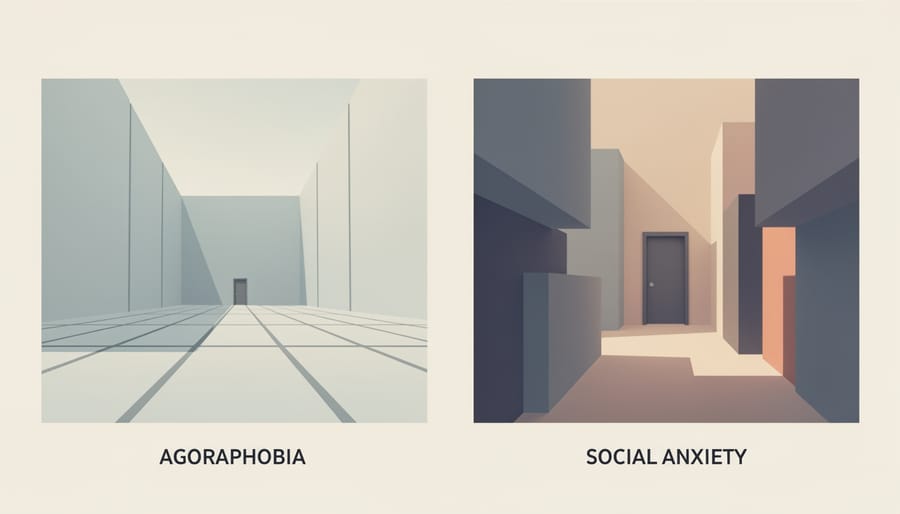 Two contrasting escape-feeling environments symbolize how fear can differ between agoraphobia and social anxiety. One doorway suggests safety/exit clarity while the other feels uncertain and restricting.
The distinction between these two conditions comes down to what your mind fixates on when anxiety strikes. If you have agoraphobia, your deepest fear centers on becoming trapped, incapacitated, or stranded without help if panic symptoms hit. You’re afraid of the physical sensations themselves, the racing heart, dizziness, feeling like you can’t breathe, and specifically of experiencing them in a place where you can’t quickly escape or where help might not reach you. The fear isn’t about what people think; it’s about being stuck in your own body’s crisis with no exit strategy.
Social anxiety disorder operates from an entirely different core fear: being negatively evaluated, judged, or humiliated by others. Your anxiety spikes at the thought of someone noticing you’re anxious, saying something foolish, or being rejected. The physical symptoms matter primarily because others might see them and judge you for them.
This creates strikingly different patterns in real situations. Someone with agoraphobia might attend a crowded party and feel perfectly comfortable if they’re near the door, know exactly how to leave, and trust that help is accessible. Remove those reassurances, say, they’re in the middle of a packed concert venue, and the anxiety surges. Meanwhile, someone with social anxiety might handle that same concert just fine if they’re anonymous in the crowd, but freeze at the thought of giving a toast at a small dinner party where all eyes are on them. The crowd size matters less than the social scrutiny.
Avoidance Patterns: What Gets Avoided and Why
 A crowded transit setting shows the physical tension of feeling unable to get away. The image conveys how escape difficulty can drive avoidance in agoraphobia.
With both conditions, avoidance becomes a survival strategy, but what you’re running from tells the story of which disorder you’re facing.
If you have agoraphobia, you’re avoiding specific locations and situations where you fear becoming trapped or unable to escape if panic symptoms hit. Your world narrows around physical spaces:
Typical agoraphobia avoidance:
- Shopping malls, grocery stores, or crowded venues where exits aren’t immediately visible
- Bridges, tunnels, or highways where you can’t pull over easily
- Public transportation like buses, trains, or planes where you’re confined
- Standing in line or sitting in the middle of a theater row
- Open spaces like parking lots or parks where help seems far away
Social anxiety, by contrast, steers you away from interactions where others might scrutinize you:
Typical social anxiety avoidance:
- Work presentations, speaking up in meetings, or any performance situation
- Parties, networking events, or casual social gatherings
- Phone calls, especially to strangers or authority figures
- Dating, asking someone out, or intimate conversations
- Eating or drinking in front of others who might notice your hands shaking
Both patterns involve safety behaviors, checking for exits, rehearsing conversations, bringing a trusted person along, but the underlying motivation differs completely. With agoraphobia, you’re securing escape routes. With social anxiety, you’re minimizing opportunities for judgment.
Panic Symptoms and Physical Reactions
The relationship between panic symptoms and each condition reveals a fundamental difference in what drives the fear.
With agoraphobia, panic attacks often sit at the heart of the anxiety. About 30-50% also have panic disorder and the terror frequently centers on experiencing overwhelming panic symptoms in a place where escape would be difficult or embarrassing. The fear isn’t just about having a panic attack, it’s about having one on a crowded subway, in the middle of a bridge, or far from home where help might not reach you. Someone with agoraphobia might feel their heart racing and immediately think, “What if I collapse here and can’t get out?” This anticipatory anxiety creates a vicious cycle where worrying about panic actually triggers the very symptoms they’re trying to avoid.
Social anxiety involves physical symptoms too, sweating, trembling, blushing, voice shaking, but the fear operates differently. Here, the terror is that others will notice these visible signs of anxiety and judge you for them. You’re not worried about being trapped; you’re worried about being seen as weak, incompetent, or foolish. The same racing heart that terrifies someone with agoraphobia (because it might escalate to full panic) terrifies someone with social anxiety because colleagues at the meeting might notice.
Both conditions benefit from learning techniques to stop a panic attack but the therapeutic work addresses different core fears.
Comorbidity: What Often Comes Along
Neither agoraphobia nor social anxiety disorder typically shows up alone. Both conditions have high rates of comorbidity, meaning they often coexist with other mental health challenges, though in notably different patterns.
Agoraphobia affects about 1 to 2% of the population in a given year. For those living with it, 30 to 50% also have panic disorder. This overlap makes sense when you understand that agoraphobia often develops as a response to panic attacks, the fear of having those terrifying physical symptoms in places where escape feels impossible or help unavailable. Depression and other anxiety disorders frequently appear alongside agoraphobia too, particularly when avoidance behaviors become so limiting that they disrupt daily life and relationships.
Social anxiety disorder presents an even more complex picture, with comorbid up to 90% of patients experiencing additional mental health conditions. The most common companions include generalized anxiety disorder, depression, and substance use disorders. Sometimes people turn to alcohol or other substances as a way to manage the overwhelming fear of social scrutiny, which can then create its own set of problems.
Why does understanding these patterns matter? Because effective treatment needs to address the whole picture, not just one isolated condition. If your therapist only targets your social anxiety but misses the underlying depression, or focuses on agoraphobia without recognizing panic disorder, you might see limited progress. A comprehensive assessment helps ensure your treatment plan addresses everything you’re experiencing, giving you the best chance at meaningful recovery.
How They’re Diagnosed: What to Expect
Getting a clear diagnosis starts with seeing a mental health professional who’ll conduct a thorough clinical interview. There isn’t a simple blood test or scan for these conditions, diagnosis relies on your experienced symptoms matching established clinical criteria, which is why professional evaluation matters so much.
For agoraphobia, clinicians look for marked anxiety lasting at least six months in two situations where escape might be difficult or help unavailable. The diagnostic process typically involves discussing which specific situations trigger your anxiety, whether you’ve developed avoidance patterns, and how these fears impact your daily life. Your provider will also ask about panic symptoms, since agoraphobia often involves fear of experiencing panic-like sensations without being able to get help.
Social anxiety disorder diagnosis focuses on whether you experience persistent fear in social situations where you might be scrutinized or judged. The clinician will explore which social contexts trigger anxiety, how you respond to these situations, and whether the fear is disproportionate to the actual threat. They’ll distinguish between everyday nervousness and the intense, persistent fear that characterizes the disorder.
- Clinical criteria-based diagnosis
- Mental health professionals diagnose these conditions by comparing your symptoms to established criteria in the DSM-5-TR, not through medical tests. This approach relies on your reported experiences and observed patterns.
- Duration requirement
- For agoraphobia, symptoms must persist for at least six months to meet diagnostic criteria. This time threshold helps distinguish the disorder from temporary anxiety or adjustment reactions.
- Situation count for agoraphobia
- Diagnosis requires marked anxiety in at least two different situations (like public transportation and open spaces). This multi-situation pattern differentiates agoraphobia from specific phobias.
- Differential diagnosis
- The process of distinguishing between similar conditions based on specific symptom patterns, triggers, and feared outcomes. This matters especially when agoraphobia and social anxiety share overlapping features.
The diagnostic process can get complex when symptoms overlap, which happens more often than you might think. Your provider might ask detailed questions to pinpoint whether you’re primarily afraid of being trapped without escape (agoraphobia) or of social judgment (social anxiety). Some people meet criteria for both conditions, which affects treatment planning.
Be honest about your experiences during evaluation. The more accurately you describe your fears, avoidance patterns, and how symptoms affect your life, the clearer your diagnosis will be. This clarity isn’t just about labeling, it’s about finding the right treatment approach that addresses what you’re actually struggling with.
Treatment Approaches: Different Paths to Recovery
 This supportive setting symbolizes how diagnosis and treatment planning happen in a safe space. It reflects the message that both conditions are treatable with evidence-based help.
While agoraphobia and social anxiety disorder share some surface similarities, their treatment paths diverge in important ways that reflect their different core fears. Both conditions respond well to professional intervention, but the specific focus of therapy shifts based on what you’re actually afraid of.
For agoraphobia, treatment centers heavily on exposure therapy, a form of cognitive-behavioral therapy that gradually helps you face the situations you’ve been avoiding. Your therapist works with you to create a hierarchy of feared situations, starting with less challenging scenarios (maybe sitting in a parked car) and building toward harder ones (driving on a highway or navigating a crowded mall). The goal isn’t just to white-knuckle through panic, but to learn that the feared catastrophe, being trapped without escape or help, doesn’t actually happen. This process retrains your brain’s threat response and builds genuine confidence in your ability to handle these situations.
Social anxiety treatment also uses exposure therapy, but pairs it more intensively with cognitive restructuring. That means examining and challenging the beliefs driving your fear: the conviction that others are judging you harshly, that you’ll humiliate yourself, or that any sign of anxiety will be catastrophic. Your therapist helps you test these predictions in real social situations and discover that people aren’t scrutinizing you as intensely as you fear, and that even visible anxiety doesn’t lead to rejection.
Both conditions may benefit from medication, typically selective serotonin reuptake inhibitors (SSRIs) or serotonin-norepinephrine reuptake inhibitors (SNRIs), which can reduce baseline anxiety and make therapy more manageable. Some people use medication short-term while building coping skills; others find longer-term use helpful.
Treatment format matters too. Individual therapy offers personalized attention, while group therapy for social anxiety provides real-world practice in a supportive environment. Many organizations now offer digital support options, providing accessible resources when in-person treatment isn’t immediately available. The key is finding an approach that matches your specific symptoms, circumstances, and readiness for change, not forcing yourself into a one-size-fits-all solution.
Which Diagnosis Fits Your Experience? Finding Clarity
If you’re reading this article because something in your life doesn’t feel right, you’re already taking an important step. Figuring out whether your experience aligns more with agoraphobia or social anxiety disorder starts with honest reflection about what’s really happening when anxiety hits.
Ask yourself: what am I actually afraid of in these moments? If your primary fear is being trapped somewhere without an easy way out or being unable to get help if panic symptoms overwhelm you, that points toward agoraphobia. If your fear centers on what people might think of you, how you might embarrass yourself, or being judged or rejected in the moment, social anxiety is the more likely fit.
Here’s another useful question: would I be comfortable in a crowd if I were invisible? Someone with agoraphobia might still feel anxious even if no one could see them, because the fear is about the situation itself and the lack of escape, not about social scrutiny. Someone with social anxiety would likely feel relief if they could be present without being noticed or evaluated.
Consider your avoidance patterns too. Do you cancel plans because you’re worried about being stuck in traffic, in a crowded store, or on a bridge? That suggests agoraphobia. Do you back out because you dread small talk, fear saying something stupid, or worry about people seeing you sweat or blush? That leans toward social anxiety.
These questions can help point you in the right direction, but they’re not a substitute for professional diagnosis. Given that up to 90% of people with social anxiety disorder have comorbid conditions, and 30 to 50% of those with agoraphobia also experience panic disorder, the picture can be genuinely complex. A mental health evaluation by a qualified professional is essential for accurate diagnosis, especially when symptoms overlap or when you’re dealing with more than one condition.
Getting clarity isn’t about labeling yourself. It’s about understanding what you’re facing so you can access the right support and treatment. Both conditions are treatable, and knowing which one fits your experience is the first real step toward feeling better.
What Each Option Is
Before we compare these two conditions, let’s establish what we’re actually talking about. Both agoraphobia and social anxiety disorder are recognized anxiety disorders, but they’re fundamentally different experiences.
Agoraphobia is intense anxiety about being in situations where escape might be difficult or help unavailable if panic-like symptoms develop. The fear centers on becoming trapped or incapacitated without access to safety or assistance. People with agoraphobia often avoid crowds, shopping malls, public transportation, bridges, or driving, not because of the places themselves, but because of what might happen if they experience overwhelming anxiety there. The diagnostic criteria require marked anxiety lasting at least six months in at least two such situations. About 1 to 2% of the population experiences agoraphobia in a given year, with 30 to 50% also having panic disorder.
Social anxiety disorder, also known as social phobia, is persistent fear of social situations driven by worry about judgment, embarrassment, or rejection from others. The core fear is being negatively evaluated by people around you. This goes well beyond normal shyness, it’s an intense, limiting anxiety that affects up to 90% of people with comorbid conditions. The fear isn’t about being trapped; it’s about being seen, scrutinized, and potentially humiliated.
Dimension-by-Dimension Comparison
When you’re trying to understand whether your experience aligns more with agoraphobia or social anxiety disorder, several key dimensions reveal the distinction.
What triggers the anxiety. With agoraphobia, specific places and situations spark fear, think crowded shopping malls, public transportation, bridges, or open parking lots. The common thread is difficulty escaping or getting help if panic symptoms strike. Social anxiety disorder triggers differently: presentations at work, parties, phone calls, or even eating in front of others. The situation matters only because other people are watching and potentially judging.
Why you’re avoiding it. Someone with agoraphobia avoids the grocery store because they fear becoming trapped or incapacitated without access to help. Someone with social anxiety avoids the same store worrying that others will notice their trembling hands or flushed face and think poorly of them. The avoidance looks similar from the outside but stems from fundamentally different fears.
Your relationship with panic. About 30 to 50% of people with agoraphobia also have panic disorder, and the fear often centers on experiencing panic symptoms in a place where escape feels impossible. With social anxiety, physical symptoms like sweating or blushing are feared primarily because others might notice them, not because they signal danger.
If you’re uncertain which pattern fits your experience, a social anxiety test can offer initial insight, though professional evaluation remains essential for accurate diagnosis.
Who Should Choose Which
Understanding which condition fits your experience isn’t about self-diagnosis, professional evaluation is essential, especially given that up to 90% of people with social anxiety disorder have comorbid conditions. However, recognizing patterns in your own symptoms can help you seek the right kind of help and communicate more clearly with mental health professionals.
If your primary fear centers on being trapped or unable to escape during panic-like symptoms, and you avoid places like shopping malls, crowded spaces, or driving because you worry about what would happen if you couldn’t get out quickly, agoraphobia is likely the more relevant diagnosis. You might feel perfectly comfortable at a party if you know the exits and can leave easily, but terrified in a theater with assigned seating in the middle of a row.
If your main concern is what others think of youand you avoid situations like presentations, dating, or phone calls because you fear judgment or embarrassment, social anxiety disorder probably describes your experience better. You might be fine driving on a remote highway but paralyzed by the thought of speaking up in a meeting.
The most important step is reaching out for professional support. Don’t let mental health stigma delay getting clarity about what you’re experiencing, both conditions respond well to treatment when properly diagnosed.
Common Questions About Agoraphobia and Social Anxiety
Can you have both agoraphobia and social anxiety disorder at the same time?
Yes, it’s absolutely possible to have both conditions simultaneously. Social anxiety disorder has comorbid disorders in as many as 90% of patients, and the overlapping avoidance patterns can make it challenging to recognize where one condition ends and the other begins. A mental health professional can help untangle which symptoms belong to which diagnosis and develop a treatment plan that addresses both.
Is one condition more severe than the other?
Neither condition is inherently more severe, both can range from mild to completely debilitating depending on the individual. Severity depends on how much the condition restricts your daily life, your ability to work or maintain relationships, and whether you have co-occurring disorders like panic disorder or depression. What matters most is getting appropriate treatment for whichever condition you’re facing.
How long does treatment typically take?
Treatment duration varies widely based on symptom severity, whether you have comorbid conditions, and how you respond to therapy. Many people notice improvement within 12-16 weeks of starting cognitive-behavioral therapy, though treatment for agoraphobia focuses on exposure therapy which requires gradual progression through feared situations. Some people continue therapy for months or even years to maintain gains and prevent relapse, while others achieve their goals more quickly.
What should I do if I’m not sure which condition I have?
The best step is to schedule an evaluation with a mental health professional who can conduct a thorough assessment. Diagnosis is based on clinical criteria that require professional judgment, especially since agoraphobia involves marked anxiety for at least six months in at least two situations, and many people experience overlapping symptoms. Don’t let uncertainty delay seeking help, even if you can’t name exactly what you’re experiencing, describing your symptoms to a professional is the starting point for getting the right support.
These questions reflect the confusion many people feel when trying to understand their own experiences. About 30 to 50% of people with agoraphobia also have panic disorder, which adds another layer of complexity to self-understanding. The high comorbidity rates, with social anxiety disorder showing comorbid conditions in as many as 90% of patients, mean that what you’re experiencing might not fit neatly into a single diagnostic box.
If you’re wrestling with these questions personally, know that professional diagnosis isn’t just about labeling your experience. It’s about understanding the specific fears driving your symptoms so treatment can target what actually needs to change. Someone whose core fear is being trapped without escape needs different therapeutic focus than someone whose primary worry is social judgment, even if both people avoid the same shopping mall.
The uncertainty itself can feel overwhelming, but it doesn’t have to prevent you from taking the first step. You don’t need to arrive at a therapist’s office with your diagnosis figured out. Describing what situations you avoid, what you fear might happen, and how your symptoms affect your life gives a clinician the information they need to help you find clarity, and more importantly, to start the path toward feeling better.
Understanding whether you’re dealing with agoraphobia or social anxiety disorder isn’t just about labeling your experience. It’s about finding the right path forward. These conditions share surface-level similarities, both involve anxiety, both lead to avoidance, both can feel overwhelming. But the differences run deep. Agoraphobia centers on fear of being trapped without escape or help when panic symptoms strike, while social anxiety revolves around fear of judgment and negative evaluation by others. Those distinct core fears require different treatment approaches to be truly effective.
If you recognize yourself in what you’ve read here, that recognition is valuable. Maybe you’ve realized your anxiety spikes when you think about being stuck in a crowded mall, or perhaps you’ve identified that your real fear is what people think when you speak up in meetings. Either way, you’re one step closer to getting help that actually addresses what you’re going through.
Both conditions are treatable. Cognitive-behavioral therapy has proven effectiveness for agoraphobia and social anxiety disorder alike, though the specific focus differs. Many people see significant improvement with the right support, and recovery looks different for everyone, it might mean confidently taking the subway again, or it might mean speaking at your best friend’s wedding without spiraling beforehand.
You don’t have to figure this out alone. Professional evaluation can clarify which diagnosis fits your experience, especially important given how often these conditions appear alongside others. Our organization offers resources, digital support options, and ways to connect with people who truly understand what living with anxiety feels like. Reaching out isn’t admitting defeat. It’s choosing yourself, and choosing the possibility that things can get better. They can.