Being “addicted to anxiety” means unconsciously maintaining anxious thoughts and behaviors even when you want relief, because your brain has learned to treat anxiety as safer or more familiar than the unknown alternative. It’s not a clinical addiction in the traditional sense, but the pattern works similarly: your nervous system gets stuck in a loop where anxiety itself becomes the default setting, and letting it go feels more threatening than holding on.
If you’ve ever caught yourself catastrophizing about something unlikely, recognized you were spiraling, and then kept doing it anyway, you know exactly what this feels like. You might rehearse worst-case scenarios before every social event, check your phone compulsively for bad news, or feel strangely uncomfortable on calm days when nothing’s wrong. The pandemic amplified this experience dramatically. Between 2020 and 2022, the World Health Organization reported a 25% increase in anxiety and depression worldwide as lockdowns and uncertainty created conditions where hypervigilance felt necessary for survival. Many people’s nervous systems never fully powered down afterward.
What makes this pattern so confusing is that it contradicts everything we believe about human nature. Why would anyone choose to stay anxious? The answer lies in how your brain prioritizes predictability over happiness, and how anxiety can serve hidden functions you might not recognize: a shield against disappointment, an identity that feels solid when everything else shifts, or proof that you’re taking life seriously.
This article will help you understand the neurological and psychological mechanisms that keep anxiety cycles running, identify the specific ways you might be maintaining your own anxious patterns, and discover what your anxiety is actually protecting you from. Most importantly, you’ll learn practical approaches to interrupt these cycles with compassion rather than self-blame, because understanding why you stay stuck is the first step toward genuine change.
What ‘Addicted to Anxiety’ Really Means
When someone says they’re addicted to anxiety, they’re not describing a chemical dependency. They’re describing a pattern where anxiety has become so familiar that it feels like the brain’s default setting, even when there’s no immediate threat. Your nervous system can learn to expect and even seek out anxious states because they’ve become the baseline you know how to navigate.
Think of it this way: if you’ve spent months or years in a heightened state of worry, your brain adapts. That constant hum of unease starts to feel normal, and calm can actually feel strange or wrong. This isn’t the same as having an anxiety disorder, though the two often overlap. Clinical anxiety involves persistent, excessive worry that interferes with daily life and may require professional treatment to understand the difference between normal vs abnormal responses. Anxiety addiction, on the other hand, describes what happens when you unconsciously maintain or recreate anxiety because somewhere along the way, being anxious started serving a purpose.
- Anxiety Habituation
- The process by which the nervous system becomes accustomed to elevated stress states, treating high anxiety as the new normal baseline.
- Psychological Addiction
- A behavioral pattern where anxiety becomes a learned response that feels necessary, familiar, or even rewarding despite causing distress.
- Anxiety Baseline
- The level of nervous system activation your body has adapted to expect and maintain, regardless of actual environmental demands.
- Safety Behaviors
- Actions performed to prevent feared outcomes that actually reinforce anxiety by preventing you from learning that the threat wasn’t real.
- Hypervigilance Cycle
- A self-reinforcing loop where constant scanning for threats creates more perceived danger, justifying continued vigilance.
The distinction matters because it shifts how you think about recovery. You’re not weak for feeling anxious. Your brain simply learned that anxiety was useful, protective, or at least predictable. Understanding this pattern opens the door to unlearning it.
How the Anxiety Addiction Cycle Works
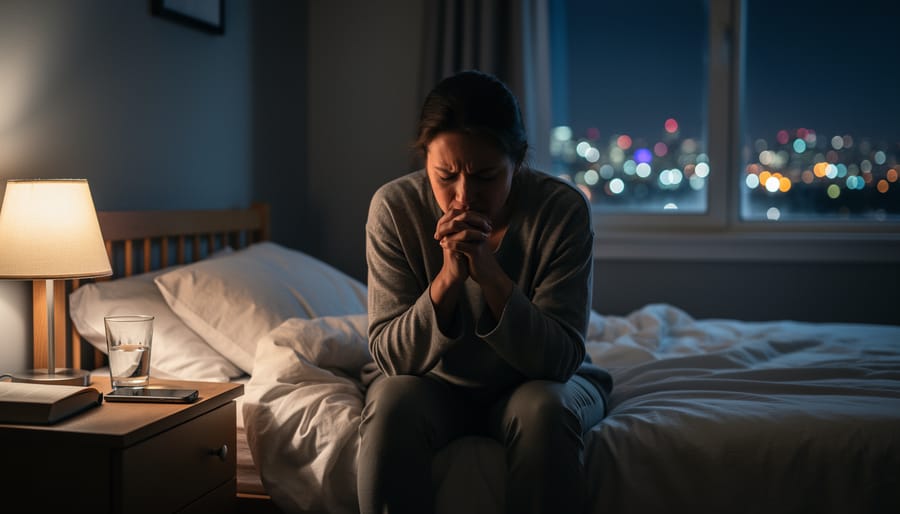 A late-night scene captures how anxiety can feel gripping and familiar, even when you want relief. The blurred window suggests uncertainty beyond the room.
The Neurological Foundation
Your brain wasn’t designed to stay anxious indefinitely, but it can learn the pattern surprisingly well. The amygdala, your brain’s threat detector, scans constantly for danger. When it finds something (real or imagined), it triggers the stress response: cortisol and adrenaline flood your system, sharpening focus and preparing your body to act. In short bursts, this saves lives. But when anxiety becomes chronic, the amygdala stays hyperactive, finding threats everywhere. Research shows a strong connection between amygdala activity and anxiety particularly when the threat detection system becomes oversensitive.
Meanwhile, your prefrontal cortex, the part that reasons, plans, and calms you down, gets overwhelmed. High cortisol levels actually impair its function, making it harder to think clearly or talk yourself down. You’re left with a loudly firing alarm system and a weakened ability to shut it off.
Over time, your nervous system adapts to this elevated baseline. You become wired for anxiety. The body treats “stressed” as normal, and calm starts to feel foreign, even unsafe. This isn’t a personal failing. It’s your nervous system doing exactly what repeated patterns taught it to do.
The Psychological Pull
Anxiety operates on a level deeper than logic. Even when we consciously want relief, part of us resists letting go because anxiety has become psychologically useful in ways we rarely examine.
The most seductive pull is the illusion of control. Worry tricks us into believing we’re doing something productive. If we mentally rehearse every possible disaster, map out contingency plans, or replay conversations searching for hidden meanings, we feel like we’re managing risk. The truth? Worry doesn’t prevent bad outcomes, but the mental activity creates a sense of agency in an uncertain world. It’s exhausting work that produces nothing except the feeling that we tried.
Beyond control, anxiety becomes who we are. When you’ve been the “worrier” in your family, the vigilant friend who spots problems, or the employee who anticipates every obstacle, anxiety isn’t just something you experience. It’s woven into your identity. Letting it go means asking “who am I without this?” That question can feel more threatening than the anxiety itself.
Perhaps most paradoxically, we fear calm. Peace feels unfamiliar, exposed, vulnerable. When your nervous system has run on high alert for months or years, relaxation doesn’t register as safety. It registers as the eerie quiet before something goes wrong. We’ve learned that bad things happen when we’re not prepared, so we unconsciously recreate tension to feel ready. The discomfort of anxiety becomes preferable to the discomfort of not knowing what comes next.
Types of Anxiety Patterns That Become Addictive
 The coiled rope symbolizes how anxiety can become a familiar “habit” that still feels binding. The ocean backdrop adds a sense of turbulence beyond control.
Productive Worry
Productive worry feels virtuous. It masquerades as preparation, as due diligence, as the mark of a responsible person who thinks ahead. You rehearse difficult conversations before they happen, mentally walk through every potential complication of tomorrow’s meeting, and run endless “what if” scenarios about decisions that haven’t even materialized yet. This isn’t random anxiety, it feels purposeful, like you’re doing important cognitive work.
The pattern reinforces itself through a powerful psychological trick: occasionally, your worrying coincides with avoiding a problem. You obsessively checked your calendar and caught a scheduling conflict. You rehearsed a conversation and it went smoothly. Your brain registers these moments as proof that the worry worked, that it prevented disaster. What it doesn’t register are the thousands of hours spent worrying about things that never happened, or the problems you solved despite not worrying about them at all.
This type of anticipation anxiety becomes addictive because it creates the illusion of control. Planning feels active, worry feels protective, and the mental rehearsal gives you something to do with the uncertainty you can’t actually eliminate. The uncomfortable truth? Most of what you worry about either won’t happen or will unfold differently than you imagined, rendering all that preparation useless. But the feeling of productivity keeps you coming back.
Crisis Mode Comfort
Some people feel most themselves when everything’s on fire. Not literally, but that sense of adrenaline-fueled clarity during a deadline crisis, family emergency, or personal drama can become oddly comfortable. If you’ve noticed you’re sharper, more decisive, or strangely energized when problems pile up, you might be unconsciously seeking that familiar intensity.
The trouble comes during calm stretches. Peace feels wrong, boring, even suspicious. Without a crisis to manage, you might find yourself creating one: picking fights, catastrophizing small issues, or taking on unnecessary burdens. It’s not sabotage exactly; it’s your nervous system searching for the activation level it knows best.
This pattern often intensifies during uncertain times. Many people discovered during pandemic lockdowns that the collective crisis gave them a strange sense of purpose, finally, the world matched their internal state. When things settled, that baseline anxiety had nowhere productive to go, so it manufactured new emergencies to solve.
The cost? Exhaustion masquerading as productivity, and relationships strained by manufactured urgency. Real rest feels dangerous when crisis mode is your comfort zone.
Hypervigilance as Safety
Hypervigilance feels like responsible caution, constantly checking your surroundings, monitoring your heartbeat for irregularities, replaying conversations for hidden meanings, scanning your body for signs of illness. It creates the illusion that your vigilance itself prevents disaster. If you stay alert enough, nothing bad can slip through unnoticed.
This pattern often intensifies during prolonged stress. Many people whose anxiety increased during pandemic lockdowns found themselves unable to turn off the threat-scanning even when immediate danger passed. The nervous system, primed for months to detect risk in every cough, every surface, every social interaction, doesn’t easily recognize when it’s safe to stand down.
The exhausting truth is that hypervigilance rarely prevents actual harm, it just ensures you experience potential threats repeatedly in your mind before they might occur in reality. You’re not protecting yourself; you’re living through disasters on loop. The body begins to interpret constant alertness as normal, and relaxation starts to feel like dangerous negligence.
When calm feels like dropping your guard rather than finding safety, hypervigilance has become its own trap.
Why We Stay Anxious: The Hidden Payoffs
Identity and Self-Perception
Over time, anxiety can stop being something you have and start being something you are. You might identify as “the worrier” in your family, the friend who always spots potential problems, or the colleague who never misses a detail because you’re constantly scanning for what could go wrong. These identities feel solid, even defining. They explain your behavior to others and give you a recognizable role in your relationships and work.
The trouble is, when anxiety becomes part of your self-concept, letting it go can feel like losing yourself. Who would you be without that vigilance? If you’re not the one anticipating disaster, what’s your purpose? This identity fusion makes anxiety feel necessary rather than optional. You might resist techniques that promise calm because, at some level, being calm doesn’t match who you believe you are. The familiar discomfort of anxiety confirms your identity, while peace feels foreign, even irresponsible.
Protection from Disappointment
Chronic anxiety serves as a form of emotional insurance, a way to cushion ourselves against the sting of disappointment. When you expect the worst, there’s a perverse comfort in knowing you won’t be caught off guard. If the job interview goes poorly, you’ve already rehearsed that outcome a hundred times. If the relationship ends, you’ve been preparing for it from the beginning.
This protective strategy feels rational in the moment, but it comes with steep costs. Living in constant anticipation of negative outcomes means you never fully experience positive ones. Even when good things happen, anxiety whispers that they’re temporary or that you’ve simply delayed the inevitable collapse.
This pattern also creates a self-fulfilling prophecy. When you brace for rejection, you may unconsciously hold back from opportunities or connections. The very protection you’ve built becomes the thing that ensures disappointment, validating the belief that anxiety was justified all along.
Connection and Validation
Anxiety often becomes a social currency, a way we connect, communicate needs, and receive attention we might not know how to ask for directly. When sharing our worries consistently brings comfort, concern, or validation from others, we learn that anxiety opens doors that calm confidence doesn’t. Friends might respond more attentively to our catastrophic thinking than to our good news. Family members might offer help when we’re spiraling but withdraw when we seem fine.
This social reinforcement is particularly powerful because it addresses a real need, connection and being seen, through an unhealthy medium. Over time, the anxious role can become our most reliable way to feel cared for, making it frightening to let go even when we desperately want relief. We’re not manipulating; we’re using the tools that have historically worked to meet legitimate human needs for support and understanding.
Breaking the Habit: How Anxiety Addiction Is Addressed
Recognizing When You’re Seeking Anxiety
The hardest anxious moments to spot are the ones we create ourselves. You might notice you check the news compulsively before bed, guaranteeing you’ll lie awake worrying. You rehearse difficult conversations that haven’t happened yet, and may never happen, until your chest tightens. You pick fights or imagine catastrophes right when things feel peaceful. These aren’t accidents.
Start observing without fixing. When anxiety rises, pause and ask: “What was I doing or thinking just before this feeling started?” You might catch yourself catastrophizing about a minor email, seeking reassurance for the fifth time, or mentally listing everything that could go wrong with tomorrow’s plan. Notice if calm moments make you uncomfortable enough that you fill them with worry.
Track your patterns in a simple log: what triggered the anxiety, what you were hoping the worry would accomplish, and whether you felt oddly relieved once the familiar tension returned. This isn’t about blaming yourself, it’s about seeing the moments when anxiety feels like a choice you’re making, even if unconsciously. Recognition is the foundation. You can’t change a pattern you don’t see.
Building Tolerance for Calm
 This image reflects how “calm” can feel unfamiliar, making you hesitate to move forward. The soft natural light suggests safety that takes practice to trust.
For many people stuck in anxiety patterns, peace doesn’t feel peaceful, it feels wrong. When your nervous system has been running on high alert for months or years, calm can trigger alarm bells. Your brain interprets the absence of tension as a threat itself, whispering that you’re being careless or that disaster is coming precisely because you’ve let your guard down.
This physiological discomfort with safety is why recovery requires more than just learning relaxation techniques. You need to gradually retrain your nervous system to recognize that calm is safe, not dangerous. Start with micro-doses of non-anxious states: five minutes of sitting without problem-solving, a short walk without mentally rehearsing conversations, deliberately not checking your phone during a specific window.
These small exposures work like physical therapy for an overused muscle. Your body will initially resist, you might feel restless, guilty, or experience a surge of anxious thoughts trying to pull you back. This is normal. The discomfort means you’re working exactly where you need to. Evidence-based relief approaches often include nervous system regulation practices that help your body learn what safety actually feels like, creating new neural pathways that don’t require constant vigilance to feel secure.
Finding What Anxiety Was Protecting
Beneath every anxiety pattern lies something your nervous system believed it was protecting. Maybe anxiety kept you vigilant when life genuinely felt unsafe. Perhaps it justified saying no to overwhelming demands or created distance in relationships that required boundaries you didn’t know how to set. Sometimes anxiety becomes the socially acceptable reason to step back when the real need is rest, space, or permission to prioritize yourself.
This deeper work asks: What would I need if I couldn’t use anxiety as the reason? The answer often points toward conversations you’ve avoided, decisions you need to make, or parts of your life requiring change. When you meet these legitimate needs directly, establishing actual boundaries, building genuine safety, tolerating uncertainty in small doses, anxiety loses its protective job. You’re not abandoning the need; you’re finding a way to meet it that doesn’t require constant suffering.
Common Questions About Being Addicted to Anxiety
Can you really be addicted to anxiety?
Yes, though it’s not an addiction in the substance-dependency sense. Your brain can become habituated to anxious states to the point where they feel normal or even necessary, creating patterns that are genuinely difficult to break even when you consciously want relief.
Does this mean my anxiety isn’t real or serious?
Absolutely not. Recognizing anxiety patterns doesn’t minimize clinical anxiety disorders or the genuine suffering they cause. Understanding how your brain maintains certain patterns can actually validate why anxiety feels so hard to shake and inform more effective treatment approaches.
How do I know if I’m stuck in an anxiety pattern?
Notice whether you feel restless or uncomfortable during calm moments, whether you unconsciously create problems to solve, or whether worrying feels like a responsibility you can’t put down. If anxiety feels familiar while peace feels foreign or dangerous, you may be maintaining patterns beyond what current threats warrant.
Can I break this pattern on my own?
Some people make progress through self-awareness and gradual practice, but professional support usually makes the process safer and more effective. Trauma-informed therapy is particularly important if your anxiety developed as protection from past experiences, including missed PTSD symptoms that can drive ongoing hypervigilance.
These questions reflect the confusion many people experience when they first encounter the concept of anxiety addiction. The framework can feel simultaneously validating and unsettling. You might recognize yourself in these patterns while also worrying that acknowledging them somehow makes your struggle less legitimate.
The reality is that understanding anxiety as a pattern your nervous system has learned doesn’t diminish the very real distress it causes. It simply offers a different lens for approaching change. When you see anxiety as something your brain is doing rather than something inherently wrong with you, the path forward often becomes clearer.
Starting to shift these patterns typically begins with observation rather than immediate change. Notice when you reach for worry, when calm feels threatening, when you manufacture urgency. This awareness itself, practiced without judgment, begins to create small gaps in automatic responses where choice becomes possible.
 The fading storm reflection represents anxiety easing as you learn to tolerate safety. Ripples suggest change without needing to control everything.
If you’ve recognized yourself in these patterns, that’s not something to feel ashamed about. Understanding that anxiety can become a habit, a familiar baseline, or even a protection strategy doesn’t mean your struggles aren’t real. It means your brain has been doing what it thought was necessary to keep you safe. The very fact that you’re reading this, questioning your relationship with anxiety, shows you’re ready to examine patterns that no longer serve you.
Change doesn’t require you to flip a switch and suddenly feel calm. It starts exactly where you are now, with awareness. Noticing when you reach for worry, when you create problems to solve, or when peace feels more unsettling than stress is powerful information. You’re not broken for feeling this way. You’ve developed coping strategies that made sense given what you’ve experienced, especially during the uncertainty of recent years.
You don’t have to navigate this alone. A mental health evaluation can help you understand your specific patterns and what’s maintaining them. Mental Health Support offers both digital and face-to-face services designed to meet you where you are. Working with someone trained in evidence-based anxiety management strategies means you’ll have guidance as you learn to tolerate calm, identify what your anxiety was protecting, and build new responses that actually feel safe.
The path forward isn’t about eliminating anxiety entirely. It’s about changing your relationship with it, so it becomes useful information rather than a constant companion. That shift is possible, and you’ve already taken the first step.