When anxiety tightens its grip, you don’t need a therapist’s office or an hour of meditation to find relief. You need something that works right now, wherever you are. Grounding techniques offer exactly that: simple, evidence-based methods that shift your focus from racing thoughts to the present moment, calming your nervous system in five minutes or less.
These aren’t just feel-good exercises. Research shows that grounding techniques actively reduce stress hormones and help manage distressing thoughts by anchoring your attention to immediate sensory experiences. Whether you’re dealing with general worry or workplace anxiety before a big presentation, these tools give you back a sense of control when everything feels overwhelming.
Sarah, a teacher who uses grounding daily, puts it simply: “I used to feel paralyzed when panic hit during my commute. Now I have techniques I can use on the subway, and no one around me even knows I’m doing them.”
The beauty of grounding lies in its accessibility. You don’t need special equipment, privacy, or training. The 5-4-3-2-1 technique, body awareness exercises, and mental grounding methods work because they interrupt the anxiety cycle by redirecting your brain’s attention away from what-ifs and toward concrete, manageable sensory input.
What follows are seven proven grounding techniques chosen specifically for their speed, discretion, and effectiveness. Each takes under five minutes. Each can be done anywhere. And each has helped countless people move from feeling trapped by anxiety to feeling present and capable again.
Key Takeaway: These grounding techniques reduce stress hormones and help manage distressing thoughts in the moment by shifting your focus from worries to your immediate surroundings. They’re scientifically validated, work in under five minutes, and can be used discreetly in any workplace setting.
Why These 7 Techniques Work for Workplace Anxiety
The seven techniques in this guide weren’t chosen at random. They’re evidence-based techniques featured by trusted health sources including Healthline, Therapist Aid, Cleveland Clinic, and Harvard Health, organizations that rigorously evaluate mental health interventions before recommending them to the public.
These particular methods meet four essential criteria that make them ideal for workplace anxiety. First, they work quickly, all seven can be completed in under five minutes, often in just one or two minutes. When anxiety hits during a tight deadline or before a presentation, you need relief now, not after a lengthy meditation session.
Second, they’re discreet enough for professional settings. You can practice any of these at your desk, in a meeting, or even during a video call without drawing attention. There’s no need for special equipment, apps, or a private space.
Third, each technique actively redirects your attention to the present moment. Therapist Aid explains that grounding methods shift focus away from uncomfortable thoughts, memories, and worries by anchoring you in what you can observe right now. This intentional redirection interrupts the anxiety spiral before it escalates.
Finally, these approaches produce measurable physical benefits. Cleveland Clinic notes that grounding techniques can reduce stress hormones and calm your body, mind, and soul. By engaging your senses, sight, sound, touch, taste, and physical awareness, you activate your parasympathetic nervous system, which counteracts the fight-or-flight response driving your anxiety.
1. The 5-4-3-2-1 Technique: Engage All Five Senses
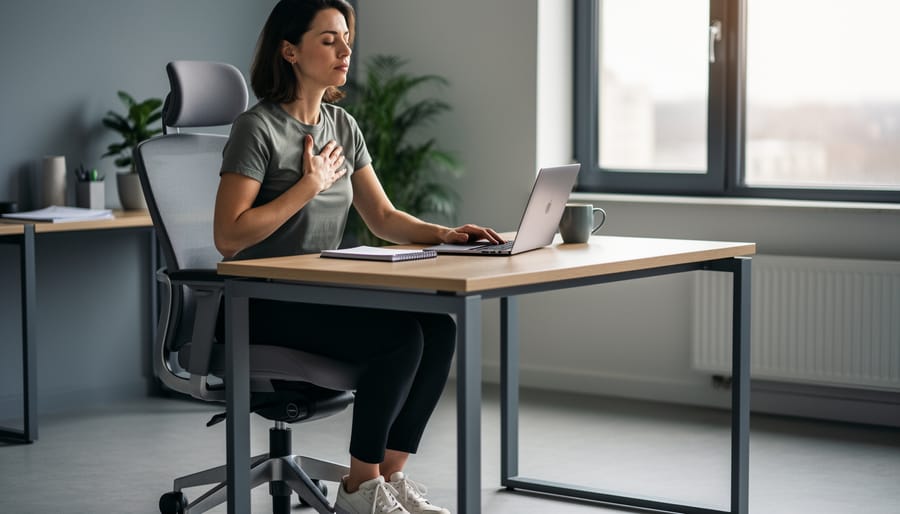 A calm workplace moment shows how grounding can start right at your desk through touch and body awareness.
When anxiety hits during a high-pressure work moment, the 5-4-3-2-1 technique gives you an immediate anchor. This method works by deliberately engaging all five senses to pull your attention away from spiraling thoughts and back to what’s physically around you right now.
Here’s how it works: Start by looking around and identifying five things you can see. Your computer screen, a coffee mug, the edge of your desk, a colleague’s jacket, the clock on the wall. Name them silently or out loud. Next, notice four things you can physically touch. The smooth surface of your phone, the fabric of your chair, the cool metal of a pen, the texture of paper. Actually touch them if you can.
Now tune into three sounds you can hear. Maybe it’s the hum of the air conditioning, keyboard clicks from across the room, or distant conversation. Then identify two things you can smell. Your coffee, hand lotion, or even just the neutral scent of your workspace. Finally, notice one thing you can taste. The lingering flavor of your lunch, a mint, or simply the taste in your mouth.
The entire process takes about two minutes once you get familiar with it. What makes this technique so effective is how it interrupts the anxiety loop by giving your brain a specific, present-focused task that requires your full attention.
Sarah, a marketing manager in Chicago, keeps a note about this technique on her desk. “When I feel my chest tightening before a presentation, I run through the 5-4-3-2-1 countdown. By the time I reach ‘one thing I taste,’ my breathing has slowed and I feel steadier. It doesn’t make the anxiety disappear completely, but it makes it manageable enough that I can do my job.”
2. Category Listing: Mental Distraction That Works
When anxiety builds at work, sometimes your brain needs a job that pulls it away from the spiral. Category listing does exactly that, it gives your mind something concrete to focus on instead of uncomfortable thoughts or worries. This technique works through simple mental distraction: pick any category you like, dog breeds, cities you’ve visited, types of pasta, cartoon characters, flowers, and silently list as many examples as you can.
The beauty of this method is its flexibility. If “countries” feels overwhelming, switch to “colours I can see around me.” If food makes you anxious, try “movie titles with one-word names.” You’re in control, which matters when anxiety makes everything feel chaotic. Like the 3-3-3 rule category listing redirects your attention from internal distress to external or neutral thoughts.
This grounding technique works because it occupies your working memory, the mental space anxiety tries to dominate. When you’re actively thinking “golden retriever, poodle, beagle, labrador,” you’re giving your brain less room to replay that uncomfortable email exchange or anticipate the afternoon meeting. You can do this anywhere, during a break, while walking to the printer, even sitting at your desk, without anyone knowing. Most people find they can generate enough items to create a noticeable shift in two to three minutes.
3. Body Awareness Scan: Reconnect with Physical Presence
When anxiety hits during a workday, your mind races ahead while your body stays anchored in the moment. A body awareness scan brings those two back together by directing your attention systematically through physical sensations from head to toe.
Start at the crown of your head. Notice any tension, warmth, or pressure. Move your attention down to your forehead, jaw, and neck, common spots where workplace stress settles. You’re not trying to change anything, just observing what’s there. Continue down through your shoulders, arms, and hands. Notice how your fingers feel resting on your keyboard or desk.
Shift focus to your chest and notice your breathing without controlling it. Move through your torso, hips, and legs, ending at your feet flat on the floor. The entire scan takes two to three minutes.
This technique works brilliantly in office settings because it requires zero external tools or visible movement. You can practice it during a conference call with your camera off, while reviewing documents, or sitting at your desk between tasks. No one around you will know you’re grounding yourself.
The physical inventory pulls your awareness away from anxious thoughts and into concrete sensations happening right now. Your racing mind slows down when you give it something specific to notice instead of worry about.
4. Touch and Texture Focus: Use What’s Around You
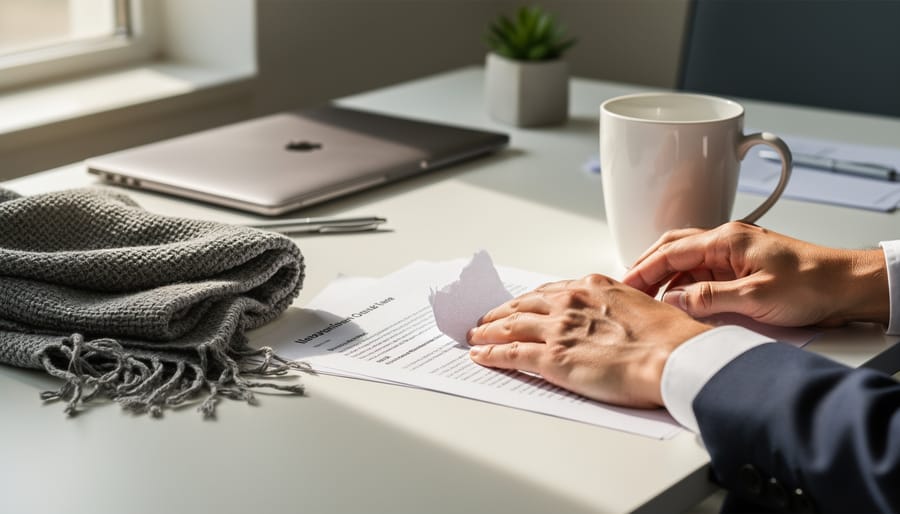 Objects on a desk, paper, ceramic, and fabric, can become anchors for tactile grounding when anxiety rises at work.
Touch and texture grounding works because it forces your attention to physical sensation rather than anxious thoughts. When you deliberately focus on how something feels in your hands or under your fingers, you activate the parts of your brain responsible for processing touch and texture, which interrupts the anxiety spiral happening in your mind.
This technique is perfect for the workplace because the objects are already there. Run your fingers along the edge of your desk and notice whether it feels smooth, cool, slightly rough. Pick up a pen and feel its weight, the ridges on the grip, the temperature of the metal clip. Touch the fabric of your chair or sleeve and pay attention to whether it’s soft, scratchy, warm, or cool against your skin.
The key is to fully concentrate on the physical sensations. Don’t just touch the object, truly notice what it feels like. Is it hard or yielding? Bumpy or smooth? Heavy or light? Warm from your hand or cool to the touch? This deliberate focus on texture pulls your awareness away from what’s causing anxiety and anchors it firmly in the present moment.
You can practice this technique anywhere in your workspace without anyone noticing. It calms both body and mind by activating your sensory awareness and reducing the stress hormones that fuel anxiety.
5. Sound Identification: Listen to Your Environment
When anxiety builds at work, your office becomes a soundscape waiting to ground you. Sound identification shifts your attention from racing thoughts to the acoustic details of your immediate environment, no special equipment needed, just your ears and a moment of focus.
Start by pausing whatever you’re doing. Close your eyes if that feels comfortable, or keep them open and soften your gaze. Listen without judgment, identifying and mentally naming each distinct sound you notice. The hum of the air conditioning. A colleague’s keyboard clicks three desks over. The muffled ring of a phone down the hall. Someone’s footsteps passing by. The rustle of papers. Your own breathing.
The key isn’t to find pleasant sounds or block out annoying ones, it’s simply to notice what’s actually there. This practice pulls you out of anxious mental loops and anchors you firmly in the present moment, where the sounds exist right now, not in your worries about tomorrow’s presentation or this morning’s tense email exchange.
You can practice this for thirty seconds during a bathroom break or stretch it to three minutes at your desk. No one needs to know you’re using a grounding technique; you’re just listening to the world around you, giving your nervous system permission to settle.
6. Breathing with Sensory Awareness: Combine Breath and Presence
This technique pairs focused breathing with close attention to how each breath feels in your body. Start by sitting comfortably and taking a slow breath in through your nose. Notice the coolness of air entering your nostrils, feel your chest and belly expand, sense the slight pause at the top of the inhale. Then exhale slowly through your mouth, paying attention to the warmth of air leaving, the gentle fall of your shoulders, the release of tension.
The key is observing physical sensations rather than just counting breaths. Where do you feel the air moving? Which muscles engage? What temperature is the air? This dual focus, breath plus bodily awareness, anchors you firmly in the present while activating your parasympathetic nervous system.
Research shows grounding techniques like this can reduce stress hormones and calm your body quickly. That physiological shift happens because controlled breathing signals safety to your nervous system, interrupting the anxiety cycle.
You can practice this sitting at your desk, in a restroom stall, or even while waiting for a video call to start. Three to five conscious breaths with full sensory awareness often provide noticeable relief. The beauty of this method is its simplicity, you always have your breath available, making it one of the most accessible grounding tools in your workplace anxiety toolkit.
7. Describe Your Surroundings in Detail: Narrate What You See
 A relaxed silhouette by a window captures the calming effect of grounding breathing and present-moment awareness.
This technique turns you into a silent narrator of your own present moment. When anxiety pulls your thoughts toward worry or past experiences, you mentally describe everything you see around you in precise, objective detail, as if you’re creating a word picture for someone who can’t be there.
Start with the largest object in your view and work toward smaller details. “I see a white wall with three framed certificates. The middle frame has a black border. There’s a gray filing cabinet to the left with a small plant on top, the plant has thick, waxy leaves.” Continue this detailed observation, noting colors, shapes, textures, and positions without judgment or emotional commentary.
The power of this sight-focused method lies in its demand for your full attention. Your brain can’t simultaneously construct detailed visual descriptions and maintain anxious thought patterns. This makes it particularly effective when you need to stop a panic attack or interrupt intrusive memories that feel overwhelming.
You can practice this technique during any moment at your desk, in a conference room, or even while walking through your office. The act of describing grounds you firmly in where you actually are, not where your anxiety wants to take you.
Making Grounding Techniques Work at Your Workplace
Knowing the techniques is one thing, but weaving them into your actual workday takes a bit of intention. The good news is that most of these methods are so discreet your colleagues won’t even notice you’re using them. The 5-4-3-2-1 technique, body awareness scan, and sound identification are virtually invisible, you can practice them during a meeting, on a video call with your camera on, or while sitting at your desk. Touch and texture focus works well if you have a stress ball, pen, or textured object within reach. Category listing and describing your surroundings happen entirely in your mind, making them perfect for high-pressure moments when you can’t step away.
The best time to start practicing is before anxiety peaks. Try one or two techniques during calm moments so they become familiar. When stress does hit, you’ll already know which methods feel most natural to you. Here are a few practical ways to make grounding part of your routine:
- Practice during low-stress moments first so the techniques feel automatic when you need them
- Identify which one or two techniques feel most natural and comfortable for your work setting
- Keep a simple reminder list in your phone notes or desk drawer with your preferred methods
- Combine grounding with other workplace supports like scheduled breaks or mental health support resources
Think of grounding techniques as tools you carry with you, not rigid rules. Some days the 5-4-3-2-1 technique will anchor you perfectly; other times, focusing on breath and body sensations will work better. Building your personal grounding toolbox means experimenting until you find what genuinely helps you return to the present moment when workplace anxiety tries to pull you away.
When to Seek Additional Support
Grounding techniques are powerful tools, but they’re part of a broader approach to managing anxiety, not a substitute for professional help when you need it. If workplace anxiety is disrupting your daily life, affecting your sleep or relationships, or if you find yourself avoiding work situations regularly, it’s time to reach out for additional support. Similarly, if grounding techniques provide only temporary relief and anxiety returns stronger, or if you’re experiencing panic attacks, persistent dread, or physical symptoms that interfere with your work, these are signs that professional guidance can make a real difference.
Note: Our team offers real-time support through our helpline, social media channels, and face-to-face services across the UK, all available to support you in 2026 and beyond.
Seeking help isn’t a failure; it’s a strength. Many people find that working with a therapist helps them understand their anxiety triggers and develop personalized coping strategies that complement grounding techniques. Your GP can also discuss treatment options, including talking therapies or medication if appropriate. You deserve support that meets your needs, and combining grounding exercises with professional care often provides the most effective path forward.
Your Questions About Grounding Techniques Answered
You might have questions about how grounding techniques fit into your workday or whether they’ll actually help when anxiety hits. Here are answers to what people most often ask.
How quickly do grounding techniques work?
Most people notice a shift in their anxiety within 1-3 minutes of starting a grounding exercise. The techniques work by redirecting your brain’s focus to the present moment, which helps reduce stress hormones and calm your nervous system almost immediately.
Can I use these during meetings?
Absolutely. Techniques like the 5-4-3-2-1 method, body awareness scans, and sound identification can be done silently while you’re sitting at a conference table or on a video call. No one needs to know you’re grounding yourself.
What if one technique doesn’t work for me?
That’s completely normal. Different grounding methods work for different people and different situations. Try several techniques to build your personal toolbox, then use whichever feels most natural and effective in the moment.
Are these scientifically proven?
Yes. Trusted health organizations including Cleveland Clinic, Harvard Health, and Therapist Aid recommend grounding techniques because research shows they help manage distressing thoughts, shift focus away from uncomfortable memories and worries, and reduce stress hormones in the body.
Grounding techniques work specifically for workplace anxiety because they’re designed to help when you can’t leave your environment. Unlike some anxiety management strategies that require privacy or specific conditions, these methods meet you where you are, at your desk, in a meeting, or anywhere stress shows up during your workday.
You now have seven practical, science-backed techniques that can calm workplace anxiety in moments, not hours. Each one works in under five minutes, fits discreetly into your workday, and requires nothing but your own awareness. You don’t need special equipment, a private space, or permission to take care of yourself when anxiety surfaces.
Start with just one or two techniques that feel most natural to you. Maybe the 5-4-3-2-1 method resonates, or perhaps focusing on textures around your desk feels more accessible. There’s no wrong choice. What matters is having these tools ready when you need them, and knowing that managing workplace anxiety is an ongoing practice, not a one-time fix.
Some days will be harder than others, and that’s completely okay. These grounding techniques work best when practiced regularly, even when you’re feeling calm, so they become second nature during stressful moments. You deserve support, and you’re not alone in navigating workplace anxiety. Taking these small, intentional steps to ground yourself is an act of self-compassion, and it counts.