GHK-Cu is a small, naturally occurring peptide made of three amino acids (glycine, histidine, and lysine) that binds tightly to copper. Your body produces it, and levels tend to fall as you age. Researchers have studied copper peptide GHK-Cu for decades, mostly in the context of skin repair, wound healing, and tissue renewal.
If you’re here because you’ve seen the name pop up and want a straight answer, that’s a smart place to start. Maybe you’re curious about copper peptide GHK-Cu for yourself, or you’re a family member or clinician trying to separate real science from marketing noise. Many people feel unsure about where the evidence is solid and where it’s still thin, and that uncertainty can quietly add to stress. If worry tends to creep in when you read health claims, our guide to anxiety 101 offers gentle, practical grounding.
This overview walks through what GHK-Cu is, how it appears to work, what it’s used for, and how strong the research really is. Take it at your own pace, and talk with a qualified health professional before making any decisions about your care.
Key Takeaway: GHK-Cu is studied as a signaling molecule that may influence copper delivery, collagen activity, and inflammation. Lab results are promising but don’t automatically prove the same benefits in people, so it’s worth treating bold claims with healthy curiosity.
What GHK-Cu Means in Plain Language
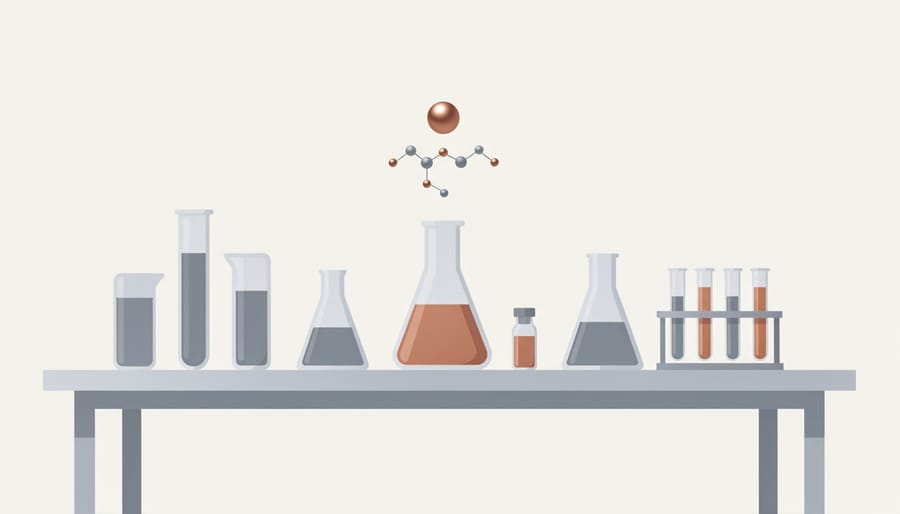 A lab-bench scene with copper-toned elements helps ground the article’s definition-first explanation of GHK-Cu.
GHK-Cu is a tiny molecule made of three amino acids linked together: glycine, histidine, and lysine. That’s where the “GHK” comes from, the first letters of each building block. The “Cu” is the chemical symbol for copper, and it tells you the peptide is carrying a copper ion, which it grips tightly. Put it together and you have a copper-binding peptide.
Researchers first identified it in human blood plasma, the liquid part of blood. Its natural levels appear to be higher in younger people and lower in older adults, which is one reason it has drawn scientific curiosity. Seeing a pattern in the body, though, isn’t the same as proving it does anything specific.
If these terms are new, here’s a quick glossary:
- Peptide
- A short chain of amino acids. Think of it as a very small piece of what a protein is made from.
- Amino acid
- The basic building blocks the body uses to make peptides and proteins.
- Copper complex
- A molecule holding onto a copper ion, which is how GHK-Cu exists.
- Collagen
- A structural protein that helps give skin and connective tissue their support.
- Antioxidant
- A substance that may help limit damage caused by unstable molecules called free radicals.
- In vitro vs. human studies
- In vitro work happens in cells in a lab dish, while human studies involve actual people, and results from one don’t always carry over to the other.
It also helps to separate three words that often get blurred. A peptide is a short chain, a protein is a much longer and more complex chain, and a supplement is simply a product category, usually something you swallow to add to your diet. GHK-Cu is a peptide, and calling something a supplement doesn’t tell you whether it has been tested or what’s actually inside.
How GHK-Cu Is Thought to Work in the Body
Think of GHK-Cu as a messenger. When tissue is stressed or damaged, the body needs to tell its repair crew where to go and what to do. Researchers suspect this small peptide may help pass along some of those instructions.
One proposed role involves copper itself. Cells need small amounts of copper to run enzymes involved in building tissue and handling oxidative stress. Because GHK binds copper so readily, scientists think it may help move copper to cells in a form they can use, while keeping it from floating around loose, where it could cause harm.
A second idea centers on signaling. In lab experiments, GHK-Cu appears to nudge certain genes and cell behaviors linked to tissue repair. In cultured skin cells, for example, it has been associated with increased collagen production and activity in the extracellular matrix, the supportive scaffolding that surrounds cells and gives tissue its structure and firmness. That scaffolding is constantly being broken down and rebuilt, and GHK-Cu is thought to influence that balance.
Researchers have also observed antioxidant and anti-inflammatory effects in laboratory settings. In some studies, the peptide seemed to dial down inflammatory signals and help cells cope with oxidative stress, both of which play a part in how tissue heals and ages.
Here’s the important caveat. Most of these findings come from cell cultures and animal studies, which are useful for generating ideas but can’t tell us what happens in a living person. The exact mechanisms are still being worked out, and scientists don’t yet agree on how much each one matters.
Understanding this difference between “observed in a dish” and “proven in humans” can be a steadying tool. It lets you stay curious about new research without feeling pressured to act on every exciting headline.
Where GHK-Cu Is Used and Studied
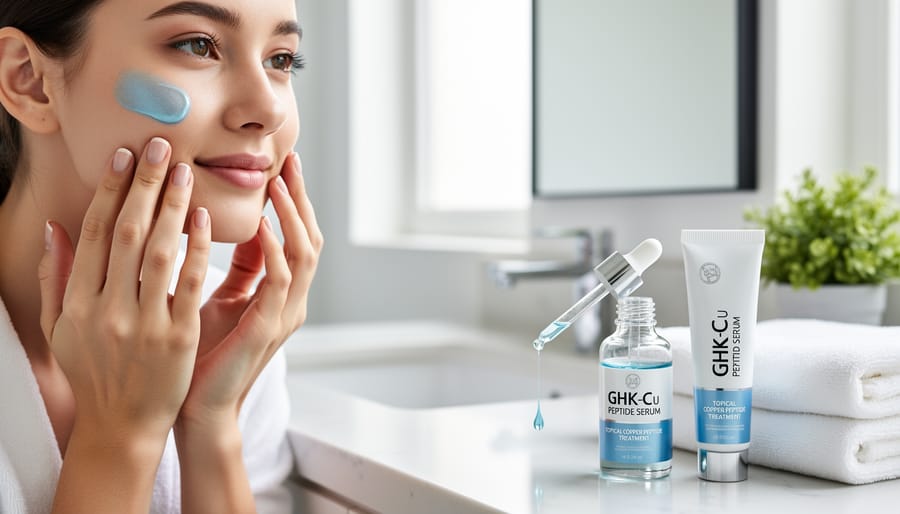 This skincare moment visually supports the section on where GHK-Cu is used and studied, especially in topical products.
GHK-Cu shows up in a few different places, and it helps to keep them separate. Some are everyday products you can buy at a store, some are experiments in a lab, and some are items sold online with very little oversight.
Here are the main areas where it’s used or studied, along with how strong the evidence is in each:
- Skin appearance and firmness: the best-studied area, with small human studies on topical creams, though sample sizes are modest.
- Wound healing: promising results mostly from cell and animal research, with limited human data.
- Hair and scalp: early research suggests possible effects on follicles, but the evidence is thin and still developing.
- Inflammation and tissue repair: lab-based investigations only, so far too early to draw firm conclusions.
- Other early-stage work: a scattering of exploratory studies that raise questions rather than answer them.
Skincare is where most people meet GHK-Cu. Topical creams and serums are generally regarded as cosmetic products, meant to affect how skin looks and feels rather than to treat a medical condition. A handful of small studies have reported improvements in skin firmness and the appearance of fine lines. That’s encouraging, but small studies can’t tell us how well it works for everyone, or for how long.
Wound-healing and hair research are more exploratory. Much of it happens in laboratory dishes or animal models, and results there don’t always carry over to people. It’s a bit like a promising rehearsal that hasn’t yet been tested on opening night.
It’s also worth knowing that injectable and “research-grade” versions of GHK-Cu are sold online. These are a different category entirely. They aren’t the same as a cosmetic cream, and the quality, purity, and safety of unregulated products can vary widely. If you’re curious about any use beyond a standard skincare product, a conversation with a licensed healthcare professional is a wise first step. Wanting answers is completely understandable, and you deserve reliable ones.
What the Research Can and Can’t Tell Us Yet
 A quiet reading-and-reflection scene illustrates how readers can slow down, ask questions, and stay grounded when evaluating wellness claims.
Here’s the honest picture: the research on GHK-Cu is interesting, but it’s still early. Knowing where the gaps are helps you read claims with a steadier eye.
Start with who and what has been studied. Many of the most striking findings come from cells in a lab dish or from animals. That’s a legitimate first step in science, but a result in a petri dish doesn’t always carry over to a living person. The human studies that do exist, mostly on topical skin products, tend to be small. A few dozen participants can hint at a pattern, but they can’t settle the question. Some were also run or funded by companies with a stake in the outcome, which is worth keeping in mind.
Long-term data is another gap. We know little about what happens when people use GHK-Cu for years, or how different doses and delivery methods compare. And product quality varies widely. A cream from a regulated skincare brand and a vial bought from an online seller may have almost nothing in common, even if both say “GHK-Cu” on the label.
This is where marketing can race ahead of evidence. A promising early finding gets stretched into “proven to reverse aging” or “heals everything,” and the nuance disappears along the way.
To show how this can play out, here’s an illustrative story (a composite, not a real individual). Imagine someone who has been feeling run down and anxious about their health. They see a post praising a copper peptide as a cure-all and feel a strong pull to order it right away. Instead, they pause. They look for the actual studies, notice most were done in cells, and bring their questions to their doctor. They don’t leave with a miracle, but they do leave feeling calmer and more in charge of the decision.
Wanting to feel better is completely valid. You deserve information that respects that hope without exploiting it, and asking questions is a sign of self-care, not skepticism for its own sake.
Taking Care of the Whole You: Staying Grounded Amid Wellness Trends
Health worries have a way of snowballing. One article about a promising peptide turns into an hour of scrolling, and suddenly every headline feels like a decision you’re supposed to make today. If that sounds familiar, you’re not alone, and nothing is wrong with you for feeling it.
When a claim catches your eye, slow down and check it. Ask who is making it, whether they’re selling something, and whether the evidence comes from people, animals, or cells in a dish. Look for the original study rather than a summary. Then bring your questions to a doctor or pharmacist before trying anything new.
Remember, too, that sleep, steady support, and regular professional care do far more for your wellbeing than any single trend. If a decision starts to feel heavy, try some grounding techniques to settle your body first, or explore ways to reduce anxiety fast when worry spikes.
You don’t have to sort it out alone. Talking with a licensed professional can help, and our guide can help you find the right therapy. Our support programs and community channels are also open whenever health decisions feel like too much.
Common Questions About GHK-Cu
Is GHK-Cu natural, and is it the same as a supplement?
GHK-Cu occurs naturally in the body, first identified in human blood plasma. But a naturally occurring molecule isn’t automatically a supplement, and products labeled with its name can differ a lot in form, purity, and how they’re meant to be used.
Does it have proven anti-aging effects?
Not in a settled, definitive way. Some small studies on topical use have looked at skin appearance and firmness, but the research is limited, and many findings come from cell or animal work.
Is it safe and regulated?
Safety depends heavily on the product and how it’s used, and long-term human data is still limited. Cosmetic products, research-grade materials, and items sold online aren’t held to the same standards, so unregulated sources deserve extra caution.
Who should I ask before trying it?
A licensed healthcare provider or a dermatologist is the best place to start, especially if you have a health condition, take medications, or are pregnant or nursing.
If these answers leave you with more questions than you started with, that’s completely normal. This is an area where the science is still unfolding, and it’s okay to sit with some uncertainty rather than rushing to a conclusion.
A good rule of thumb: if a claim sounds too certain for a field that is still being studied, it probably deserves a second look. Bringing your questions to a professional you trust is a sign of good self-care, not overthinking. You don’t have to sort through all of this alone, and you can take it at whatever pace feels right for you.
So, here’s where things stand. GHK-Cu is a small, naturally occurring peptide made of three amino acids bound to copper, and it has drawn real scientific interest for its possible roles in skin, tissue repair, and inflammation. The early research is intriguing. It is also limited, with many studies done in cells or animals and plenty of questions still unanswered.
That balance is okay to sit with. You don’t have to chase every promising trend, and wanting to feel better is completely valid. You deserve honest information, the freedom to decide at your own pace, and a trusted professional to talk it through with.
If health worries or anxiety start to feel heavy, you’re not alone. Explore our educational resources and support services whenever you’re ready. We’re here.